
BODY IMAGE AND PLEASURE
How watching yourself interferes with feeling anything There is a specific and common experience that interferes with pleasure more reliably than almost any physical factor, and it has nothing to do with the body's actual capabilities. It is the experience of monitoring oneself from the outside during intimacy, of being half-present in the moment and half-occupied with how one looks while in it. The research term for it is self-objectification, and its effect on sexual response is direct, measurable, and largely invisible to the person experiencing it. The mechanism is a matter of where attention goes. Pleasure requires attention to be inside the body, registering sensation as it happens. Self-monitoring pulls attention out of the body and into an imagined external viewpoint, where it is busy evaluating the appearance of a stomach, an angle, a movement, a comparison to some remembered or imagined standard. Attention is finite. It cannot be fully inside the experience and fully observing the experience from the outside at the same time. The observation wins by default, because anxiety is loud, and what is lost is the sensation itself. Studies in this area consistently find that the habit of viewing one's own body as something to be evaluated is associated with reduced arousal, more difficulty reaching climax, and lower sexual satisfaction overall. The crucial finding underneath this is that the effect tracks with the self-monitoring, not with any objective feature of the body. Two people with bodies a neutral observer would rate identically can have entirely different experiences, determined not by how they look but by how much attention they spend watching themselves look. The body was never the variable. The watching was. This reframe matters because the usual proposed solution, changing the body itself, addresses the wrong thing. A changed body monitored just as intently produces the same interference. The problem is not the object being observed. It is the act of observing, the redirection of attention away from feeling and toward appearance. Solving it requires not a different body but a different allocation of attention. The skill being described is, in essence, the same one that appears throughout the study of pleasure, which is presence. The ability to keep attention inside the body, registering what is actually happening, rather than floating outside it to evaluate the scene. It is trainable, like any direction of attention, and it begins with noticing the moment the mind leaves the body to go watch from across the room, and gently declining the invitation. The most reliable barrier to pleasure, for an enormous number of people, is not located in the body at all. It is located in the habit of watching the body instead of inhabiting it.

TOUCH WITHOUT A DESTINATION
The science of slow, non-goal-oriented contact Almost all touch in a hurried life is functional. It is a means to an end, a step toward something else, a transaction conducted as efficiently as possible on the way to the next thing. Even intimate touch is frequently structured this way, as a sequence of steps progressing toward a defined goal, with each stage valued mainly for moving things along. There is a different way to touch, one that has no destination at all, and the nervous system responds to it in a measurably different manner. The skin contains a specialized population of nerve fibers whose purpose is not to detect pressure, temperature, or texture in the way the standard sensory system does. These fibers, sometimes described in research as the system underlying affective or emotional touch, respond specifically to slow, gentle, stroking contact at roughly the speed and pressure of a caress. They are slow-conducting, they connect to the emotional and social processing regions of the brain rather than the regions that handle precise sensory discrimination, and they appear to exist primarily to register the pleasantness of being touched by another person. What is striking about this system is that it is tuned for slowness. Fast touch does not activate it well. The very efficiency that functional touch prizes is the thing that bypasses the machinery built for the pleasure of contact itself. To engage it, the touch has to slow down to a pace that the goal-oriented mind tends to find almost uncomfortable, because the goal-oriented mind is always asking where this is going, and the answer, in this case, is nowhere. That is the point. Non-goal-oriented touch removes the destination on purpose. When there is nothing the touch is supposed to be leading toward, the pressure of progress disappears, and with it a particular kind of low-grade tension that most people do not notice until it is gone. The nervous system, no longer being managed toward an outcome, settles. Paradoxically, this settling often produces a depth of arousal that the goal-oriented approach, with all its forward momentum, never reaches, because arousal of the deeper kind tends to require a parasympathetic state that hurry actively prevents. The practice is simple to describe and surprisingly difficult to do, which is itself informative about how thoroughly most people have been trained toward efficiency. Touch slowly. Touch without trying to get anywhere. Let the contact be the entire content of the moment rather than a step toward a later one. The system built to register the pleasure of being touched has been waiting, in most people, for touch slow enough to reach it.

THE HORMONAL CLOCK OF DESIRE
Why “I’m not in the mood” usually has a measurable cause The phrase “I’m not in the mood” is treated, in most relationships, as a verdict about feeling, and feelings are mysterious, so the phrase tends to end the inquiry rather than begin it. This is a missed opportunity, because desire is not nearly as mysterious as its reputation suggests. It runs on hormones, and hormones run on patterns, and many of those patterns are predictable enough to plan around. The most familiar of these is the menstrual cycle, which produces a rhythmic fluctuation in desire that is real, well-documented, and frequently underestimated even by the people experiencing it. Across the cycle, the shifting balance of hormones moves desire up and down in ways that are consistent enough to be charted. Knowing where one is in that cycle turns an apparently random fluctuation into something legible. The dip is not a problem to be solved. It is a phase to be understood, the same way the peak is. Less discussed, and arguably more important on a day-to-day basis, is cortisol, the central stress hormone. The relationship between stress and desire is not subtle. Cortisol and the systems that govern arousal are, over the long run, in opposition. A body that is chronically flooded with stress hormones is a body that has been told, at a physiological level, that this is not the time for anything that can wait, and reproduction and pleasure can, from the body's survival-oriented perspective, always wait. The libido that disappears during a stressful month did not malfunction. It responded correctly to the signal it was given. Sleep sits underneath all of it, and its effect is larger than most people credit. Testosterone, which contributes to desire in all bodies regardless of sex, is produced significantly during sleep, and is measurably reduced by sleep deprivation. The connection between exhaustion and a flat libido is not just the obvious fatigue. It is also a direct hormonal consequence of a system that did not get the rest it needed to manufacture the chemistry of wanting. The practical reframe is this. “I’m not in the mood” is rarely a fixed fact about a person or a relationship. It is far more often a readout of measurable inputs, where one is in a cycle, how much stress the body is carrying, how much sleep it has had. Those inputs can be tracked, and many of them can be changed. Desire that looks unpredictable from the outside is often running on a schedule that simply has not been read.

THE PSYCHOLOGY OF ROLE PLAY
Why a costume quiets the part of you that watches The instinct to dress up, to adopt a persona, to play a character in intimacy, is often treated as either frivolous or faintly embarrassing, a thing for people with particular tastes rather than a tool with general utility. This underestimates what is actually happening, which is a deliberate and effective intervention on one of the most common obstacles to pleasure, the relentless self-consciousness of the observing mind. Most people carry, during intimacy, a quiet internal observer. It monitors how they look, what they sound like, whether they are doing it right, what the other person is thinking. This running commentary is the single most reliable destroyer of presence, because attention spent observing oneself is attention not spent in the experience. The technical term in the research literature is spectatoring, and it is strongly associated with reduced arousal and difficulty reaching climax. The watcher and the participant cannot both occupy the foreground at once. A persona interrupts the watcher in a specific and clever way. When you step into a character, the self-consciousness has a different target. It is no longer your ordinary self being evaluated, with all of that self's accumulated insecurities and history. It is a role, a costume, a deliberate performance, and performances are allowed to be bold in ways that the everyday self often will not permit itself to be. The character can want things openly. The character can be looked at. The character does not carry the particular shyness that belongs to you, because the character is, by agreement, not quite you. This is the same mechanism that lets shy people become expansive on a stage, or quiet people speak freely behind a mask at a party. The reduction of personal accountability does not eliminate the self. It gives the self permission. The distance created by the role is precisely what allows the desire underneath it to come forward. The fear that stops most people from trying it is the fear of feeling ridiculous, of the moment collapsing into awkward laughter. This fear is worth taking seriously, because it points at the real prerequisite, which is a shared agreement to take the game seriously enough that neither person is left exposed. The collapse into embarrassment happens when one person has committed and the other has not. The solution is not less commitment. It is mutual commitment, entered together, with the understanding that the slight absurdity is the doorway rather than the obstacle. Starting small tends to work better than starting elaborate. The point was never theatrical accuracy. The point is the distance from the everyday self, and even a small amount of that distance is often enough to quiet the watcher and let the participant take the foreground.

THE MYTH OF MALE PERFORMANCE
Where the anxiety comes from and what the physiology actually says There is a script handed to men about what their bodies are supposed to do, and it is, on close inspection, a work of fiction. It describes a body that responds on demand, performs to a consistent standard, operates independently of mood, stress, fatigue, or feeling, and treats any deviation as failure. Almost no real body works this way, and the gap between the script and the reality is the engine of an enormous amount of unnecessary suffering. The central mechanism is a feedback loop, and it is worth describing precisely because understanding it is most of the way to disarming it. Male arousal depends significantly on the parasympathetic nervous system, the branch associated with rest, safety, and the absence of threat. Anxiety activates the opposite branch, the sympathetic system, the one that governs the response to danger. These two systems are, in this context, antagonistic. The body cannot easily mount an arousal response while it is simultaneously preparing to flee from a threat. Here is where the loop closes. A man who is anxious about performance activates his threat system. The threat system suppresses the very physiological response he is anxious about. The suppression then becomes evidence, in his mind, that his fear was justified, which increases the anxiety, which further activates the threat system. The fear produces the outcome it feared, and the outcome strengthens the fear. The cause and the consequence chase each other. The cruelty of this loop is that it is self-confirming. It does not require any underlying physical problem to sustain itself. It generates its own proof. A perfectly healthy body can be locked into apparent dysfunction entirely by the anxiety about dysfunction, with no physiological cause beneath it at all. The expectations feeding the anxiety are, importantly, not drawn from reality. They are drawn from a cultural script and, increasingly, from pornography, which presents a performance standard that is staged, edited, and unrepresentative of how any body actually functions over time. Measuring oneself against it is like measuring one's daily life against an action film. The comparison was never valid, but it operates anyway, quietly, in the background. The way out of the loop is not more effort, because effort is sympathetic activation, which is the problem. The way out is the removal of the demand. When the performance stops being a test that can be failed, the threat system has nothing to respond to, and the parasympathetic system, which was always capable, is free to operate. The body was rarely the problem. The story about what the body owes was the problem.

EROTIC COMMUNICATION
The script almost nobody is taught Of all the skills involved in a satisfying intimate life, the one most consistently absent from any formal education is the ability to talk about it. People are taught the mechanics, eventually, usually badly. They are taught the risks. They are almost never taught how to say, to another person, in the moment, what they want, what they like, and what they would prefer to stop. The result is a population of adults who are physically intimate with each other while being verbally unable to direct the experience at all. The avoidance has an understandable root. Speaking a desire out loud makes it real and makes the speaker vulnerable to rejection, judgment, or simply being misunderstood. Silence feels safer. The problem is that silence does not actually produce safety. It produces guessing, and guessing produces a steady accumulation of small mismatches that never get corrected, because correcting them would require the conversation that is being avoided. Research on consent has, almost as a side effect, produced one of the more useful frameworks for this. The concept of enthusiastic consent shifted the standard from the absence of a no to the presence of a yes, and in doing so it reframed communication as something ongoing and positive rather than a single gate to pass through at the start. The relevant skill is not the one-time negotiation. It is the continuous, low-stakes exchange of signal during the experience itself. That exchange does not have to be verbal to be communication, and it does not have to be clinical to be clear. The fear that talking will break the mood usually imagines an interruption, a pause, a sudden shift into the register of a business meeting. In practice, the communication that works tends to be brief, integrated, and often non-verbal, a redirection, a sound, a guided hand. The mood-killer is not communication. The mood-killer is the silent frustration that accumulates in its absence. The asymmetry worth naming is that the cost of speaking is paid once and immediately, in a moment of vulnerability, while the cost of not speaking is paid repeatedly and quietly, over the entire length of a relationship. People consistently choose the second because the first is sharper, even though the second is larger. Understanding that trade clearly is most of what it takes to start choosing differently. The script is missing for almost everyone. It is not difficult. It is just unpracticed, and the only way to practice it is to begin saying small true things out loud and discovering that the catastrophe one feared does not, in fact, arrive.

THE MAP OF THE SKIN
The science of erogenous zones and why everyone's is different The idea of erogenous zones tends to be taught, when it is taught at all, as a fixed map. There are certain places, the diagram suggests, that are universally sensitive, and the task is simply to locate them. This model is tidy, widely circulated, and substantially wrong, and the way it is wrong reveals something genuinely useful about how the body produces sensation. Sensitivity begins with the physical distribution of nerve endings, which is real and uneven. Some regions of the body have a far higher density of sensory receptors than others. The lips, the fingertips, and certain other areas are packed with nerve endings in a way that the skin of the back, for instance, is not. This is measurable and consistent across people, and it explains why some regions reliably register more than others. But raw receptor density is only the foundation. What turns a sensitive patch of skin into an erogenous zone is the brain, and the brain's map of the body is not fixed. It is shaped by experience, attention, and association. A region that has been the site of pleasurable touch becomes, over time, more strongly wired into the brain's pleasure circuitry. The nerve endings did not multiply. The neural significance of their signals changed. This is why two people can have near-identical anatomy and completely different maps of where touch lands as pleasure. Context modulates all of it. The same touch in the same place produces wildly different sensations depending on the state of the nervous system. A touch that is electric during arousal can be neutral or even irritating when the body is not engaged, because arousal physically changes how sensory signals are processed on their way to the brain. The skin did not change. The processing did. This has a direct practical consequence. The search for a partner's sensitive places is not a treasure hunt for fixed coordinates that exist independently of everything else. It is a collaborative process of building a map that did not fully exist beforehand, and that will keep changing. Attention given to a region tends to increase its responsiveness over time. The map is not discovered. To a significant degree, it is created. The fixed-diagram model fails because it treats the body as hardware with the locations pre-installed. The body is closer to something that learns. Where it feels pleasure is, in large part, where it has learned to.

THE PELVIC FLOOR AS AN ORGAN OF PLEASURE
The muscle group almost nobody is taught to feel Most people first hear about the pelvic floor in a clinical context, usually tied to childbirth, incontinence, or a vague instruction to do an exercise whose mechanics were never properly explained. It is filed under medical maintenance, somewhere near posture and cholesterol, and almost never discussed as what it also is, which is one of the most directly involved muscle groups in sexual sensation for every body that has one. The pelvic floor is a hammock of muscle slung between the pubic bone and the tailbone. It supports the organs above it, controls the openings that pass through it, and contracts rhythmically during orgasm. That last function is the one that rarely gets mentioned, and it is the one that explains why the condition of these muscles has so much to do with the quality of sensation. When the pelvic floor is weak, the contractions that accompany climax are weaker, and the sensation is correspondingly diminished. This is the part most people have heard, if they have heard anything. What gets discussed far less is the opposite and surprisingly common problem, which is a pelvic floor that is chronically too tight. Stress, prolonged sitting, anxiety, and the simple habit of holding tension in the body all tend to settle into this region. A muscle that is permanently clenched cannot contract meaningfully, because it has no slack to contract from. It is already at the end of its range. The result is reduced sensation, discomfort, and sometimes pain, all stemming not from weakness but from the inability to release. This is why the standard advice to simply do more clenching exercises is, for a meaningful portion of people, exactly the wrong instruction. They do not need to strengthen a weak muscle. They need to teach a chronically tight one how to let go. The skill being trained is not contraction. It is conscious release, the ability to feel the difference between a held pelvic floor and a relaxed one, and to choose between them. The first step, and the one almost nobody is taught, is simply locating the muscles by sensation rather than by instruction. Most people cannot feel their pelvic floor with any precision, which means most people cannot tell whether it is weak, tight, or somewhere reasonable. Awareness comes before any exercise, because an exercise performed on a region you cannot feel is just hopeful guessing. The pelvic floor responds to attention the way any muscle group does. It can be strengthened, it can be released, and it can be brought under conscious control. What it cannot do is improve while it remains, as it does for most people, a part of the body that is never deliberately felt at all.

WHY WE SLEEP BETTER AFTER SEX
The neurochemistry of the drowsy aftermath The post-sex sleepiness is so reliable that it has become a punchline, usually aimed at men who fall asleep with unflattering speed. Like most things that are common enough to joke about, it has a precise physiological explanation, and the explanation is more interesting than the stereotype. Orgasm triggers a cascade of neurochemical events, and several of the chemicals released are directly sedating. The most studied of these is prolactin, a hormone that rises sharply after climax and is associated with the feeling of satiation, the sense that the drive has been satisfied and can now stand down. Prolactin is also released during the transition into sleep under ordinary circumstances, which is part of why the post-orgasm state and the pre-sleep state feel so neurologically similar. The body is being moved into the same gear by overlapping machinery. Oxytocin, often described in the simplistic language of a bonding hormone, also rises and contributes to the effect. Among its many functions, oxytocin lowers the activity of the stress axis, reducing cortisol and dialing down the physiological vigilance that keeps people awake. A nervous system flooded with oxytocin is a nervous system that has, chemically, been told it is safe. Safety is a precondition for sleep. The body does not surrender consciousness when it believes it needs to stay alert. There is also a drop in the brain regions associated with arousal and alertness, alongside the release of other relaxation-promoting signals. The combined effect is a body that has been moved, in the space of a few minutes, from high physiological activation into a state chemically primed for rest. The often-noted difference in how strongly this affects different people has a partial explanation in the magnitude of the prolactin response, which varies. It is not a measure of interest or affection, despite the interpretations that get layered onto it. It is a measure of a hormonal reflex. The useful point underneath the joke is that intimacy and sleep are not unrelated activities that happen to occur in the same room at the end of the day. They are biochemically linked. The same systems that produce the calm of the aftermath are the systems that govern the descent into sleep, which is why the connection between a satisfying intimate life and a well-regulated sleep cycle is real, measurable, and worth taking seriously.

THE SCIENCE OF DESIRE THAT FADES IN A RELATIONSHIP
Why wanting changes when love stays There is a particular kind of quiet panic that arrives in long relationships, usually somewhere after the first year and often much later, when one or both partners notice that the wanting has changed. It used to arrive on its own. It used to interrupt the day. Now it has to be invited, scheduled almost, and its absence is read as evidence that something is broken. The relationship is failing. The attraction is gone. One of them, or both, has stopped being desirable. This interpretation is almost always wrong, and the reason it is wrong is one of the more useful findings in the study of human sexuality over the last two decades. There are, broadly, two ways desire arrives. The first is spontaneous desire, the kind that appears seemingly out of nowhere, unprompted by anything external, the kind that dominates the cultural script of what wanting is supposed to look like. The second is responsive desire, which does not appear first and then lead to arousal. It works in the opposite order. The body and the situation create arousal, and the desire follows. The wanting is real, but it is a response rather than an initiation. Early in a relationship, novelty, uncertainty, and the steady drip of dopamine that comes with pursuing something not yet secured all tilt the system heavily toward spontaneous desire. Everything is new, and novelty is one of the most reliable triggers the human arousal system has. What people mistake for the natural state of attraction is in fact the natural state of attraction under conditions of novelty. Those conditions do not last, and they were never going to. What replaces them is not the death of desire. It is the gradual handover from spontaneous to responsive. The wanting is still there. It simply requires a context now. It requires the arousal to come first. This is not a flaw in the relationship. It is the predictable trajectory of a nervous system that has stopped treating a familiar person as an emergency and started treating them as safety. The practical consequence of understanding this is significant. Couples who believe desire should always arrive spontaneously will wait for a feeling that has structurally become less likely to come unannounced, and they will read the waiting as proof of decline. Couples who understand responsive desire stop waiting. They create the context first, with the understanding that the wanting tends to show up once the body is already engaged, not before. The shift from spontaneous to responsive desire is one of the most normal things that happens in a committed relationship. It is also one of the most consistently misread. The feeling did not leave. It changed the order in which it operates.

Touch and Texture: Why Lace, Satin, and Mesh Feel So Different on Skin
Not all fabric is created equal. Anyone who has ever slipped into satin after a day spent in cotton knows this instinctively. But the difference is not just comfort or preference. It is neurological, and understanding it changes the way you think about what you choose to wear against your skin. The human body has several distinct types of sensory receptors embedded in the skin, each tuned to detect different qualities of touch. Meissner's corpuscles respond to light, moving contact, the kind produced by soft fabric brushing across the surface of the skin. Merkel's discs respond to sustained pressure and fine texture detail. Ruffini endings register stretch and warmth. Pacinian corpuscles detect vibration and deeper pressure. When you put on a piece of lingerie, all of these receptors activate simultaneously, each sending its own signal to the brain, and the brain assembles those signals into what we experience as the feeling of a fabric. This is why different materials produce such distinctly different psychological responses, and why those responses are not arbitrary. Take satin. Its defining characteristic is a smooth, low-friction surface that glides across the skin with minimal resistance. This quality activates Meissner's corpuscles in a sustained and rhythmic way, producing a sensation that the brain tends to associate with luxury, with being touched carefully, with softness as a form of care. Research on tactile perception consistently shows that smooth, low-friction textures are rated as more pleasant and more emotionally positive than rough or high-friction ones. There is a reason satin has been associated with sensuality across cultures and centuries. The body responds to it at a receptor level. Lace is more complex. Its open, irregular structure means that it touches the skin in a pattern of contact and absence, pressure and space. This variability keeps the sensory receptors in a state of heightened attention. The brain cannot fully habituate to the sensation because it keeps changing slightly with every movement. This is part of why lace feels intimate in a way that other fabrics do not. It maintains a low-level but continuous sensory conversation with the body. Mesh operates differently again. Depending on its weight and weave, mesh can create a sensation of contained exposure, the skin is covered but still aware of air, of movement, of the boundary between inside and outside. This quality engages thermoreceptors alongside the mechanical receptors, creating a layered sensory experience that is simultaneously grounding and activating. There is also the role of temperature. Satin tends to warm quickly to body temperature, creating a sensation of the fabric becoming part of the skin. Mesh and open lace maintain more air circulation, keeping a slight temperature differential that the body remains aware of. These thermal signals are processed in the same brain regions as emotional warmth and social connection, which is part of why the feeling of certain fabrics can shift your emotional state in ways that seem disproportionate to something as simple as getting dressed. None of this is accidental in well-designed intimate apparel. The choice of fabric is a choice about how you want your nervous system to feel. Grounded and enveloped. Alert and exposed. Softened and cared for. At Tangere, fabric selection is part of every decision we make about what to carry. Because the way something feels on your skin is not secondary to how it looks. In the most intimate moments, it is the whole point.

The Afterglow Explained: What Science Says About Post-Intimacy Bonding
Most people have experienced it. That particular quality of stillness that settles in after intimacy. Time seems to move differently. The body feels both spent and awake. There is a warmth that does not seem to have a specific location. It has a name: post-coital bliss, or more commonly, the afterglow. And while it has been romanticized for centuries in poetry and art, science has spent the last two decades building a fairly detailed picture of what is actually happening in the body and brain during those moments. The short version is this: the afterglow is a real, measurable neurobiological state, and what you do during it, how you treat it, whether you honor it or rush past it, has a significant impact on the quality of your relationships and your own emotional wellbeing. Start with the neurochemistry. During intimacy, the brain releases a complex cocktail of hormones and neurotransmitters. Oxytocin, dopamine, serotonin, and endorphins all spike simultaneously. Then, in the minutes and hours that follow, they begin to recede. But they do not recede instantly. The afterglow is partly the experience of that receding, a kind of neurological tide going out slowly, leaving behind a particular quality of calm and openness. Oxytocin in particular plays a central role. This hormone, which facilitates bonding and trust, remains elevated for a measurable period after intimacy. Research published in the journal Psychological Science found that the afterglow can last up to 48 hours in some individuals, and that its intensity is directly correlated with relationship satisfaction over time. In other words, couples who experience a stronger afterglow tend to report higher relationship quality months later. This is not a coincidence. The afterglow creates a neurological window, a period during which the brain is primed for bonding, for honest communication, for emotional closeness. The defenses are lower. The self-consciousness that governs most social interaction has not fully returned. What gets said and felt during this window tends to land differently, more deeply, more lastingly, than what gets communicated at other times. There is also a physical dimension that is often overlooked. Skin-to-skin contact during the afterglow period continues to release oxytocin, which means that physical closeness in those moments is not just emotionally significant, it is neurologically active. The body is still in a state of heightened receptivity, and the textures and sensations around it, including what you are wearing, contribute to that state. This is one of the reasons why the transition from intimacy back into ordinary life deserves more intentionality than it usually gets. What you wear, how you move, the quality of attention you bring to the hour after can either extend and deepen the neurological benefits of the afterglow or cut them short. At Tangere, we think of our pieces not just as what you wear before or during, but as part of the full experience. Soft, considered, chosen with care. Because the moments after matter just as much as the moments before, and the body knows the difference.

Slow Mornings: The Case for Staying in Your Lingerie All Day
There is a particular kind of morning that does not get enough credit. No alarm pulling you out of sleep before you are ready. No immediate reach for the phone. No rushing toward the first obligation of the day. Just the slow, deliberate process of waking up inside your own life. And what you are wearing during that process matters more than you might think. The culture of productivity has colonized the morning in ways that are worth examining. The advice is almost always the same: wake early, move fast, dress for the day you want, signal to your brain that it is time to perform. There is logic to this. But there is also something lost in the relentless acceleration from sleep to output, a transition so compressed that the body barely has time to register that it has woken up. The slow morning is a counter-argument. It is the deliberate choice to let the first hours of the day belong to you, not to your schedule, not to your inbox, not to whoever needs something from you next. And one of the most underrated tools for creating that space is what you choose to stay in. Psychologists who study daily rituals and self-regulation have found that the environment we create around ourselves in unstructured time has a significant impact on our baseline stress levels and our sense of personal agency. This includes physical environment, the light, the temperature, the sounds, but it also includes what touches our skin. The tactile experience of the morning sets a tone for the nervous system that can persist for hours. Staying in lingerie on a slow morning is, at its core, a statement about ownership. Of your time. Of your body. Of the quality of your own experience. It is a refusal to immediately convert yourself into a functional, productive, presentable version of yourself for the benefit of the outside world. It is an insistence that the version of you that exists before all of that deserves an unhurried hour or two. There is also something specifically powerful about the combination of softness and intention that well-chosen intimate apparel provides. You are not in last night's clothes, which carry the energy of yesterday. You are not in functional daywear, which carries the energy of obligation. You are in something chosen for how it feels, for the particular quality of ease and sensuality it creates, and that distinction registers in the body. Research on what psychologists call ego restoration, the process by which the self recovers from the demands of social and professional performance, consistently points to the importance of unstructured, low-demand time in comfortable, personally meaningful environments. The slow morning in lingerie is, in a very real sense, a form of self-restoration. It is also, simply, a pleasure. And pleasure taken in solitude, pleasure that belongs entirely to you, is one of the more undervalued forms of self-care available. At Tangere, we think about the full arc of a piece. Not just the moment it is chosen, or the occasion it is worn for, but the slow Tuesday morning when you pour coffee and do not rush and let the fabric remind you that you are worth a few unhurried hours. That moment is as much a part of what we design for as any other.

The Fantasy Gap: What People Imagine vs. What They Actually Try
There is a space that exists in almost every person's inner life. A gap between what they find themselves imagining and what they have actually allowed themselves to experience. Psychologists have studied this space for decades, and what they have found is both illuminating and, for many people, quietly unsettling. The fantasy gap is not a sign of dysfunction. It is, in fact, one of the most consistent features of human desire. Research on sexual fantasy and intimate behavior consistently shows that the majority of people carry a rich inner life of desires and scenarios that they have never acted on, not because they lack the opportunity or the partner, but because the distance between imagining something and actually doing it involves a kind of psychological crossing that most people never quite make. This crossing requires something that is in shorter supply than most people realize: permission. Not permission from anyone else. Internal permission. The private, quiet decision that what you want is acceptable to want, that exploring it does not threaten your sense of who you are, that curiosity about your own desire is not something to be managed or contained but something to be followed. The research is striking on this point. Studies on erotic imagination and relationship satisfaction have found that people who act on a higher proportion of their fantasies report significantly greater sexual satisfaction, greater emotional intimacy with their partners, and higher overall wellbeing. The gap itself, the distance between what is imagined and what is experienced, is associated with frustration, with a low-level sense of incompleteness that is difficult to name but easy to feel. What keeps the gap open? The most common factors researchers identify are not practical. They are psychological. Shame, which operates quietly and does not always announce itself. Self-consciousness about being seen wanting something specific. The fear that desire, once expressed, changes how you are perceived. The habit of treating your inner life as something separate from your actual life. Clothing, and intimate apparel in particular, sits at an interesting intersection of all of these factors. The way you dress in private is one of the most direct expressions of your relationship with your own desire. It is a space where the fantasy can begin to become real in a low-stakes, entirely personal way. Choosing a piece that reflects something you have imagined, that moves in the direction of an aesthetic or a feeling you have only visited in thought, is a small but genuine act of closing the gap. It does not require an audience. It does not require a particular occasion. It requires only the decision that what you find beautiful and desirable about yourself is worth expressing, even if the only person present to witness it is you. The fantasy gap closes incrementally, one small permission at a time. And those permissions tend to compound. The person who allows themselves one honest expression of their desire tends to find the next one easier, and the one after that easier still. At Tangere, we think of our collection as a space where that process can begin. Not a destination, but a starting point. A place where the distance between what you imagine and what you actually wear starts, quietly, to shrink.

The Psychology of Red: Why This Color Dominates Lingerie
Walk into any lingerie section, scroll through any intimate apparel collection, and red is always there. Not as a trend that comes and goes. As a constant. A given. A color so embedded in the language of desire that its presence barely registers as a choice anymore. But it is a choice. And the psychology behind it is more layered than most people realize. Red is the most emotionally activating color in the visible spectrum. This is not a cultural construct, or at least not entirely. Research in color psychology and evolutionary biology suggests that the human response to red runs deeper than aesthetics, deeper than fashion, deeper than what any particular culture has decided to associate with romance or danger or passion. It is, in significant part, a biological response. Start with the evolutionary context. In many primate species, reddening of the skin signals fertility, health, and sexual readiness. Humans are not immune to this signal. Studies conducted across multiple cultures have found that men rate women as more attractive and more sexually appealing when they are associated with the color red, even when all other variables are held constant. The effect occurs whether the red appears in clothing, in background color, or in framing. It appears to operate below the level of conscious processing. But the psychology of red is not only about attraction from the outside. It also operates internally, on the person wearing it. Research on color and self-perception shows that wearing red increases self-reported feelings of confidence, dominance, and assertiveness. In competitive contexts, people wearing red perform better and are perceived as more formidable by opponents. In social contexts, they are rated as more charismatic and more memorable. The color does not just signal power to others. It activates a sense of power in the wearer. This is partly physiological. Red has been shown to increase heart rate and elevate arousal levels in ways that are measurable in the body. It stimulates the sympathetic nervous system, the same system activated by excitement, by anticipation, by the early stages of desire. Wearing red does not just look like energy. It generates it. There is also the cultural layer, which has accumulated over millennia and cannot be separated from the biological one. Red has been associated with love, with passion, with danger, with celebration, with the sacred across virtually every human culture that has left a record. That accumulated meaning does not disappear when you put on a red lace set. It travels with the color. Your nervous system has absorbed it, even if you have never consciously thought about it. The combination of these layers, biological signal, physiological activation, and cultural resonance, is what makes red uniquely powerful in intimate contexts. It is not simply that red looks good. It is that red does something. To the person looking. And to the person wearing. At Tangere, red is not just a color option in our collection. It is a statement. One that has been understood, across cultures and centuries, to mean something specific. You already know what it means. Your body knew before you did.

The Confidence Effect: Why What You Wear to Bed Changes Everything
There is a moment most people recognize but rarely talk about. You slip into something soft, something that fits just right, something chosen deliberately rather than grabbed out of habit, and something shifts. Not in the room. In you. It sounds almost too simple to be worth examining. But the relationship between what you wear and how you feel is backed by decades of psychology research, and it goes much deeper than aesthetics. Psychologists call it enclothed cognition. The term was coined by researchers Hajo Adam and Adam Galinsky in a 2012 study that became one of the most cited in social psychology. Their finding was straightforward but profound: clothing does not just reflect how we feel. It actively shapes how we think, how we carry ourselves, and how we engage with the world and the people in it. The mechanism is partly symbolic and partly physical. When you wear something that carries a particular meaning for you, your brain begins to operate in alignment with that meaning. A doctor who puts on a white coat becomes more focused and precise. An athlete who puts on a team jersey becomes more competitive. A person who slips into lingerie they genuinely love becomes, in a very measurable way, more present in their own body. That last part matters more than most people realize. Presence in the body is not a default state. For many people, especially those who have spent years in the habit of wearing whatever is comfortable or convenient, there is a kind of disconnection between the physical self and the emotional self. Intentional dressing, particularly in intimate contexts, can interrupt that disconnection. This is not about performance for someone else. The research is consistent on this point: the psychological benefits of what you wear occur whether or not anyone else sees you. The woman who puts on a lace set before a long Sunday morning at home is not dressing for an audience. She is setting a tone for herself. She is making a quiet statement about how she intends to inhabit the next several hours. There is also a neurological dimension worth mentioning. The skin is the largest sensory organ in the human body, and the textures that touch it send constant signals to the brain. Satin against the skin activates different receptors than cotton, than denim, than the worn fabric of whatever you grabbed last. Those signals contribute to your baseline mood, your level of arousal, your sense of ease or tension in your own body. This is why the materials matter as much as the cut, and why the cut matters as much as the color. These are not superficial choices. They are a form of self-communication, a way of deciding in advance what kind of energy you are going to bring into your own space. At Tangere, we think about this a lot. The pieces we carry are chosen not just for how they look in a product photo but for how they feel in motion, against skin, in the quiet of a room where the only person they need to impress is you. If you have never given much thought to what you wear when no one is watching, consider this an invitation to start. The confidence effect is real. And it begins the moment you decide, deliberately, what you are going to wear.

Lingerie and the Brain: What Happens When You Feel Desired
Desire is not just an emotion. It is a chemistry event. When you feel genuinely desired, a specific cascade of neurological activity begins. Dopamine rises. Oxytocin is released. The prefrontal cortex, the part of the brain responsible for self-monitoring and social anxiety, quiets down. Heart rate shifts. Pupils dilate. The body, in a very literal sense, opens. Understanding that sequence changes the way you think about intimacy, about confidence, and about the role that something as seemingly small as a lingerie set can play in how you experience your own life. Start with dopamine. This neurotransmitter is often described simply as the pleasure chemical, but that description undersells it. Dopamine is more accurately the anticipation chemical. It spikes not when you receive a reward, but when you expect one. This is why the process of getting dressed, of choosing the right piece, of feeling the fabric settle into place, can itself feel electric. Your brain has already begun the reward sequence before anything has happened. Then there is oxytocin, sometimes called the bonding hormone, though that label also simplifies something more complex. Oxytocin is released through touch, through eye contact, through moments of genuine connection. It reduces cortisol, which is the primary stress hormone, and creates a neurological environment in which vulnerability feels safe rather than threatening. The body becomes more receptive. The mind becomes less defended. The quieting of the prefrontal cortex is perhaps the most significant piece. This region of the brain is associated with self-consciousness, with the running commentary most people maintain about how they are being perceived. When it goes quiet, people stop performing and start experiencing. They become less aware of how they look and more aware of how they feel. Here is what is interesting about lingerie specifically: it can initiate this neurological shift before any external trigger occurs. The act of wearing something that makes you feel desirable, regardless of whether anyone is present to desire you, can begin to activate this same cascade. You are, in effect, giving your own nervous system a signal. Research in self-perception supports this. When people engage in behaviors associated with being desired, including wearing clothing they find attractive and sensual, their self-reported mood improves, their posture changes, and their social confidence increases. The brain does not always distinguish cleanly between feeling desired by someone and feeling desirable to yourself. This is not a small distinction. The culture around lingerie has historically framed it as something you wear for others. But the neuroscience suggests a different story: that the most powerful effect of feeling desired may begin entirely within you, and that the pieces you choose to wear are one of the most direct ways to initiate it. At Tangere, we design the experience of shopping with this in mind. The right piece is not just the one that looks best. It is the one that makes your nervous system respond. The one that starts the chemistry.

THE SECOND ORGASM: WHY THE BODY IS CAPABLE OF FAR MORE THAN ONE
There is a moment that most people treat as a conclusion. The orgasm arrives, the tension releases, and something in the body and the mind simultaneously decides that the experience is over. The curtain has come down. Whatever comes next belongs to a different category, the aftermath, the unwinding, the gradual return to ordinary consciousness. The show is finished. This assumption is so deeply embedded in how most people structure intimate experience that it rarely gets examined. It feels like biology. It presents itself as simple fact. But for a significant proportion of the population it is not biology at all. It is habit dressed as inevitability, a learned behavioral pattern so consistently repeated that it has acquired the feeling of physical law. The body's capacity for multiple orgasms is not a myth, not a rare gift distributed to a fortunate few, and not the exclusive territory of women, though the cultural conversation has largely confined it there. It is a genuine physiological possibility that exists across genders, varies considerably between individuals, and is almost universally underdeveloped because the script that ends at one has never been seriously questioned. What follows is that question, taken seriously. THE PHYSIOLOGY OF ONE Understanding what actually ends and what doesn't To understand multiple orgasms, it helps to understand with some precision what a single orgasm actually does to the body, because the common assumption, that it produces a global reset that requires time to reverse, is only partially accurate. Orgasm triggers a discharge of accumulated neuromuscular tension through the central nervous system, accompanied by rhythmic muscular contractions, a neurochemical release including oxytocin, dopamine, and endorphins, and a sharp activation of the parasympathetic nervous system. Heart rate and blood pressure, elevated during arousal, begin to return toward baseline. The subjective experience is one of release, warmth, and a particular quality of physical heaviness that most people interpret as a signal to stop. In women, the post-orgasmic body retains significant physiological arousal for a period that varies between individuals but is often longer than the behavioral response to it suggests. The clitoris remains engorged. Vaginal lubrication persists. The neurochemical environment remains conducive to further arousal. The body has not reset. It has discharged one accumulation while retaining the infrastructure for another. What most women experience as post-orgasmic hypersensitivity, the feeling that direct clitoral stimulation immediately after orgasm is too intense to be pleasurable, is real but frequently misread. It is not a signal that arousal has ended. It is a signal that direct stimulation of the same location at the same intensity is temporarily overwhelming. The distinction matters enormously. Shifting location, reducing intensity, changing the quality of touch, any of these can maintain and rebuild arousal through the hypersensitive window rather than abandoning it. THE REFRACTORY REALITY What is actually different for men The male refractory period is real in a way that the female equivalent is not, and understanding its actual mechanism, rather than its cultural mythology, is what opens the conversation about male multiple orgasm. Following ejaculation, the male body releases prolactin in significant quantities. Prolactin is directly responsible for the refractory state, producing the subjective feelings of satisfaction, heaviness, and reduced desire that follow ejaculation. It also suppresses dopamine activity, which is the primary neurochemical driver of sexual motivation. The refractory period is, in the most direct sense, a prolactin event. The critical word in that last paragraph is ejaculation. Prolactin is released in response to ejaculation, not in response to orgasm. And orgasm and ejaculation, as established in the earlier entry on male sexuality, are two physiologically distinct events that happen to coincide in most men's experience but are not inherently linked. Men who learn to experience orgasm without ejaculation do not trigger the prolactin release. The refractory period does not occur. The arousal state, temporarily dipped by the orgasmic discharge, can rebuild and produce another orgasm without the physiological obstacle that ejaculation would have introduced. This is not theoretical. It is documented in both research and in the consistent reports of men who have developed this capacity through the kind of sustained, attentive practice described in the edging entry. It requires significant bodily awareness and deliberate practice. It is not available on demand to someone attempting it for the first time. But it is available, and the gap between knowing it exists and most men ever attempting to develop it is almost entirely a product of the cultural silence around male orgasmic potential beyond its most functional expression. THE FEMALE MULTIPLE ORGASM What is actually happening and why it works The female capacity for multiple orgasms is the most documented aspect of this subject and simultaneously the most poorly understood in terms of what actually produces it. The popular framing, that some women are simply built for it and others are not, is inaccurate in a way that is worth correcting. Multiple orgasm in women is not a fixed trait. It is a capacity that develops with specific conditions, the most important of which are sustained arousal, the willingness to stay with sensation through the post-orgasmic hypersensitive window, and the absence of the behavioral shutdown that most women have been conditioned to perform after a first orgasm. The hypersensitive window varies in duration and intensity between individuals and between encounters. For some women it lasts thirty seconds. For others it lasts several minutes. Its presence does not indicate that a second orgasm is unavailable. It indicates that the approach to continued stimulation needs to change temporarily, in location, in pressure, in directness, before it can resume building. Indirect stimulation through the hypersensitive phase is the most reliable bridge. Pressure on the mons pubis rather than direct clitoral contact. Internal stimulation while the external sensitivity settles. A shift to different erogenous zones, the inner thighs, the breasts, the nape of the neck, that maintains arousal at a level sufficient to prevent the full physiological reset while allowing the acute hypersensitivity to pass. What happens on the other side of that window, for women who stay with the process rather than concluding at the first orgasm, is that the body returns to stimulation from a higher baseline than it started with. The second build begins from a point of greater physiological preparation. The second orgasm, for most women who experience it, is qualitatively different from the first, deeper, more diffuse, more whole-body in its character, not because something magical occurred but because the accumulated arousal of the entire encounter has had more time to develop. THE BLENDED APPROACH Why combining stimulation types changes the equation One of the most reliable pathways to multiple orgasm, for women especially, involves the deliberate combination of different stimulation types rather than the repeated application of the same one. This works because different forms of stimulation activate different neural pathways, and the orgasms produced through different pathways have different qualities and different post-orgasmic signatures. A clitoral orgasm followed by a period of internal stimulation, building toward a different kind of response, is not simply two versions of the same event. The nervous system is being engaged through distinct channels, and the second engagement begins from a post-orgasmic state that is specifically depleted in one area while remaining relatively fresh in others. The combination of clitoral and G-spot stimulation, either simultaneous or sequential, is particularly well-documented in this context. The blended orgasm produced by both simultaneously tends to be more intense than either alone, and the post-orgasmic state following a blended orgasm often has a different quality than the hypersensitivity that follows pure clitoral stimulation, sometimes making continued arousal easier rather than harder in the moments immediately following. Learning what your specific body's post-orgasmic landscape looks like is the foundational work here. Which areas remain sensitive, which become accessible, how long the hypersensitive phase lasts, whether internal stimulation bridges it better than external. This is precisely the kind of self-knowledge that the solo practice entry addressed. The multiple orgasm is one of its most tangible returns. THE PSYCHOLOGICAL OBSTACLE Why the body is willing when the mind concludes The most common reason multiple orgasms remain theoretical for women who are physiologically capable of them is not physical. It is the deeply conditioned behavioral pattern of concluding after one. This pattern has several sources. The cultural script that frames male orgasm as the end of the encounter, making female post-orgasmic experience feel like an inconvenient continuation of something that has already finished. The internalized performance of satisfaction, the performance of having arrived somewhere, that makes staying in arousal after orgasm feel somehow socially incorrect. And a straightforward unfamiliarity with what staying in the experience past the first orgasm actually feels like, a discomfort with territory that has never been explored. None of these are physiological obstacles. They are learned behaviors that can be unlearned with sufficient awareness and sufficient permission. The permission, as in so many of the conversations in this series, must come first from yourself. The specific permission required here is the permission to not be finished when one part of you is satisfied. To treat the first orgasm not as a conclusion but as a transition, a shift in the quality of the experience rather than its end. To stay curious about what comes next rather than defaulting to the behavioral script that says there is nothing next. What comes next, for most women who stay to find out, is considerably better than what came before. THE MALE MULTIPLE ORGASM IN PRACTICE What the development actually involves For men approaching the practice of non-ejaculatory orgasm with genuine intent rather than theoretical curiosity, the developmental path is specific enough to be worth describing in some detail. The foundation is the PC muscle, the pubococcygeus muscle that forms part of the pelvic floor and is responsible for the contractions that occur during orgasm. Developing conscious control of this muscle, through the same exercises recommended for pelvic floor health generally, creates the capacity to voluntarily contract it at the moment of approaching ejaculatory inevitability. A strong, deliberate contraction at this moment can interrupt the ejaculatory reflex while allowing the orgasmic sensation to continue. This requires precise timing and a level of bodily awareness that develops through practice rather than being available immediately. The approach is gradual. Edging practice, developed first, builds the awareness of one's own arousal threshold that makes the precise intervention possible. The two practices are directly complementary, with edging developing the map and the PC muscle work developing the tool to navigate it. Early attempts will frequently result in either ejaculation, because the intervention came too late, or in a significantly diminished orgasmic sensation, because the intervention was too forceful or too early. Both outcomes are informative rather than discouraging. The calibration develops over time, and the men who report full non-ejaculatory orgasm consistently describe the learning period as worthwhile independent of the destination, because the bodily awareness developed along the way changes the quality of every sexual experience regardless of whether the specific goal is reached. The assumption that the body is finished after one orgasm is one of the more consequential pieces of misinformation in the common sexual script. It ends experiences that haven't ended. It forecloses territory that hasn't been explored. It trains both the body and the mind to treat a transition as a conclusion, and then mistakes the habit for biology. The body is not finished. It has simply reached a familiar stopping point and is waiting to see whether you will stop there again or, this time, stay curious about what lies past it. What lies past it, for most people who have the patience and the presence to find out, is the best part of the whole landscape. The map doesn't end at one. It only begins there.

DESIRE AFTER DARK: THE SCIENCE OF WHAT HAPPENS TO AROUSAL WHILE YOU SLEEP
Sleep is the part of human experience that we understand least and control most poorly, and it is also, it turns out, one of the most sexually active periods of the human day. While the conscious mind is offline and the body appears to be doing nothing more interesting than horizontal breathing, an elaborate sequence of neurological and physiological events is unfolding that has direct, measurable consequences for sexual function, libido, and the quality of erotic experience during waking hours. Most people know, in a vague way, that erotic dreams exist. Fewer know that the sleeping body undergoes genital arousal as reliably as clockwork, regardless of dream content, regardless of age, regardless of partnered status or recent sexual activity. And almost nobody has been told that the quality of their sleep is one of the most significant and most ignored variables in the quality of their sexual life. This gap between what is happening and what people know about it is worth closing. Not because the science of sleep and sexuality is primarily practical, though it has practical implications, but because there is something genuinely fascinating about the discovery that the body is, in a very real sense, maintaining itself sexually while you are not paying attention. That desire has a nocturnal life of its own, operating according to its own logic, answering to its own rhythms, and leaving evidence in the waking body that most people have been misreading for years. THE ARCHITECTURE OF THE SLEEPING BRAIN What REM actually is and why it matters Sleep is not a uniform state. It is a structured cycle of distinct neurological phases that the brain moves through repeatedly across the night, each with its own characteristic brain wave patterns, its own physiological signatures, and its own specific functions. The phase most relevant to sexuality is REM sleep, an acronym for Rapid Eye Movement, named for the distinctive scanning motion the eyes make beneath closed lids during this stage. REM sleep is the phase most associated with vivid dreaming, and it occupies an increasingly large proportion of each sleep cycle across the night, meaning that the longest and most intense REM periods occur in the final hours of sleep rather than the first. During REM, the brain is extraordinarily active. In terms of metabolic activity and neural firing, a sleeping brain in REM is nearly indistinguishable from a waking brain engaged in complex tasks. What is suspended during REM is not neural activity but voluntary motor control, a paralysis mechanism that prevents the sleeping body from physically acting out its dreams. Everything else, including the autonomic nervous system, the limbic system, and the neurochemical processes associated with arousal, is running at full capacity. The consequence of this is genital arousal. In men, the phenomenon of nocturnal penile tumescence, erection during sleep, has been documented and studied for decades and occurs in healthy males of every age from infancy through old age, appearing with remarkable regularity during every REM cycle throughout the night. In women, the equivalent phenomenon, nocturnal clitoral tumescence and vaginal engorgement, occurs with the same regularity and has received a fraction of the research attention, largely because it is less visually obvious and therefore easier to ignore. This arousal is not caused by erotic dreams. The relationship runs in the opposite direction. The physiological arousal of REM sleep is what creates the neurological conditions in which erotic dreams are likely to occur. The body leads. The dream follows. WHY THE BODY DOES THIS The maintenance function of nocturnal arousal The biological purpose of nocturnal genital arousal is, according to current research, primarily one of tissue maintenance. Regular engorgement of genital erectile tissue delivers oxygenated blood to structures that otherwise receive relatively modest circulation during ordinary daily activity. This oxygenation prevents tissue atrophy, maintains nerve sensitivity, and preserves the physiological infrastructure of sexual function. In practical terms, this means that the body is performing routine maintenance on its sexual capacity every night, whether or not its owner has any conscious interest in sexual activity. It is a use-it-or-lose-it system operating on autopilot, ensuring that the equipment remains functional and sensitive regardless of the frequency of actual use. The implications of this extend in both directions. Men who experience erectile difficulties during waking hours but normal nocturnal tumescence during sleep are demonstrating that the physical mechanism is intact, which points toward psychological or relational factors rather than physiological ones as the source of the difficulty. The sleeping body, unburdened by performance anxiety, simply does what it was designed to do. For women, the equivalent insight applies to arousal and lubrication difficulties. A body that engorges normally during sleep has the physiological capacity for arousal. What may be preventing that capacity from expressing itself during waking hours is not the body's limitation but the conditions the waking mind creates around it. This distinction is not a small one. It changes both the diagnosis and the approach. THE EROTIC DREAM What it is, what it isn't, and what it reveals The erotic dream is one of the more universally experienced and least discussed features of human sleep. Surveys consistently find that the majority of adults experience them with some regularity, that they span the full demographic range of gender, age, and orientation, and that they frequently involve scenarios, partners, or dynamics that the dreamer would not consciously choose and may find confusing or dissonant upon waking. This last feature is worth addressing directly, because it produces a significant amount of unnecessary distress. The content of erotic dreams is not a reliable guide to waking desire. The dreaming mind operates according to associative, symbolic logic rather than the literal preferences of the conscious self. It draws from everything stored in memory, including experiences, fears, relationships, and cultural material, and recombines them without editorial control. A dream about a person you would never pursue is not a suppressed wish. A dream with a dynamic you would never choose consciously is not a hidden desire demanding expression. The dreaming brain is not a truth serum. It is a processing system that uses sexual arousal, which is already physiologically present during REM, as an emotional charge to drive whatever associative story it happens to be working through. What erotic dreams do reveal, reliably, is the current state of the dreamer's sexual energy. Frequent, vivid erotic dreams tend to accompany periods of high libido, hormonal activity, and sexual vitality. Their relative absence, or their presence in anxious or unsatisfying forms, can reflect hormonal shifts, stress load, relationship dynamics, or simply the cumulative effect of insufficient sleep. They are a barometer, not a blueprint. THE NOCTURNAL ORGASM What it is and why it matters The spontaneous orgasm during sleep, historically called a nocturnal emission in men and less commonly discussed in women despite occurring in both, is the most dramatic expression of the body's autonomous sexual activity during sleep. It occurs when the combination of REM arousal, dream content, and physiological engorgement reaches sufficient intensity to trigger the orgasmic reflex without any external stimulation. In men, this has been documented and acknowledged, if somewhat awkwardly, since adolescence is when it most commonly begins. In women, nocturnal orgasm is considerably less discussed despite being documented in research and reported by a significant proportion of women across age groups. The experience in women tends to involve the same physiological markers as waking orgasm, including uterine and vaginal contractions, clitoral engorgement, and the characteristic neurochemical release, all occurring during sleep and sometimes producing a state of partial wakefulness at the moment of climax. The nocturnal orgasm is the body at its most unguarded. There is no performance anxiety, no self-consciousness, no monitoring from a distance. The orgasm occurs because the physiological conditions were present and the nervous system did what nervous systems do in those conditions. It is, in a very pure sense, the body's own sexual expression, unmediated by the mind's complications. For many women who experience difficulty reaching orgasm during waking sexual activity, the nocturnal orgasm is significant evidence that the capacity is present. The obstacle is not physiological. It is the particular quality of self-consciousness and pressure that waking intimacy introduces, and that sleep, with its complete absence of audience, removes entirely. SLEEP QUALITY AS SEXUAL HEALTH The variable nobody talks about The relationship between sleep and sexual function runs deeper than the specific phenomena of dreams and nocturnal arousal. Sleep quality is one of the most significant determinants of libido, arousal capacity, and orgasmic intensity in both men and women, and it operates through several converging mechanisms that most people have never been told to consider. Testosterone, the hormone most directly associated with sexual desire in both sexes, is produced primarily during sleep. The majority of daily testosterone synthesis occurs during the early hours of the night, during slow-wave sleep, and is directly dependent on sleep duration and quality. A single week of sleeping five hours per night rather than eight reduces testosterone levels in young men by the equivalent of ten to fifteen years of aging. The effect in women, while less studied, follows the same directional logic. Cortisol, the primary stress hormone and one of the most reliable suppressors of sexual desire, follows the opposite pattern. Poor sleep raises cortisol levels, and elevated cortisol directly competes with the neurochemical conditions required for arousal, desire, and orgasmic response. A sleep-deprived nervous system is a cortisol-flooded nervous system, and a cortisol-flooded nervous system is one that has physiologically deprioritized reproduction and pleasure in favor of threat response. The practical implication of all of this is straightforward and almost never framed this way: protecting sleep is a sexual health practice. The eight hours that feel like a passive absence from life are actively producing the hormonal and neurological conditions that make desire, arousal, and pleasure available during the hours that follow. Treating sleep as a luxury to be traded against productivity is, among its other costs, a direct trade against sexual vitality. WHAT THE BODY IS TELLING YOU Reading the nocturnal evidence The patterns of sleep and dreams and nocturnal arousal carry information that, read with some attention, can illuminate things about the waking sexual self that are otherwise difficult to access. Periods of particularly vivid or frequent erotic dreams often correspond to hormonal peaks in the menstrual cycle, specifically the days approaching ovulation, when estrogen and testosterone are both elevated. Tracking this correspondence gives a woman a more embodied understanding of her own hormonal rhythm than any app or calendar can provide. Changes in the quality or frequency of erotic dreams, toward greater anxiety, less pleasure, more confusion, often precede the conscious recognition of stress, relational difficulty, or emotional suppression. The dreaming body notices things before the waking mind is ready to. Taking its reports seriously, not as literal truth but as emotional signal, is a form of self-knowledge that most people leave entirely untapped. And the simple fact of waking with residual arousal from a dream, that particular quality of warm, unspecific wanting that sometimes accompanies the return to consciousness, is worth treating as an invitation rather than an inconvenience. The body has done considerable preparatory work overnight. The morning, it turns out, is one of the more physiologically well-prepared moments in the day for intimacy, and the culture's insistence on treating it exclusively as a time for alarms and obligations has costs that the body registers even when the mind does not. The sleeping body is not an absence. It is a full participant in your sexual life, operating according to its own rhythms, maintaining its own systems, processing its own material, and leaving evidence each morning of the work it did while you were not watching. Understanding this changes something in how the waking hours feel. The desire that arrives in the morning is not arbitrary. The dream that left its emotional residue is not random noise. The libido that fluctuates across the week is not a mystery. The body has been communicating all along, in the language of cycles and dreams and the particular quality of arousal that belongs to different hours of the day. Learning that language is not a project for the mind. It is a practice of paying attention to the body that has been running its own curriculum, patiently, every night, whether you enrolled or not.

THE CERVICAL ORGASM: THE EXPERIENCE MOST WOMEN DON'T KNOW THEY CAN HAVE
There is a category of sexual experience that exists at the intersection of the physical and the emotional in a way that most other kinds of pleasure do not. An experience that women who have had it consistently describe in terms that sound, to those who haven't, almost implausible. Waves that move through the entire body. Spontaneous tears with no accompanying sadness. A sense of opening that feels less like sensation and more like weather. A quality of feeling that they struggle to locate in the same vocabulary as other orgasms because it doesn't quite belong there. They are describing the cervical orgasm. And the reason most women don't know they can have one is not anatomical. It is a combination of insufficient time, insufficient arousal, insufficient trust, and a near-total absence of cultural conversation about a part of the female body that most people treat as either irrelevant or something to be careful around. The cervix deserves considerably more than that. What it is capable of, under the right conditions, is one of the more profound experiences available to the female body. The conditions are specific. They are also entirely achievable. This is what they are. THE ANATOMY OF THE DEEPEST PLACE What the cervix actually is and where it lives The cervix is the lower portion of the uterus, a dense, muscular structure that protrudes slightly into the upper vaginal canal and serves as the passage between the vagina and the uterine cavity. In its everyday state it is firm, approximately the texture of the tip of a nose, and for many women it is simply a structure that exists somewhere deep inside them that they have never thought much about in an erotic context. This changes entirely during arousal. As the body moves through the stages of sexual excitement, the uterus undergoes a process called tenting, pulling upward and backward into the pelvic cavity. The cervix lifts with it, moving deeper and changing position relative to the vaginal walls. Simultaneously, the cervix itself begins to soften, becoming more receptive to pressure in a way that the unaroused cervix absolutely is not. The cervix that feels uncomfortable or neutral when touched without sufficient arousal and the cervix that is capable of producing profound orgasmic sensation are, physiologically, the same structure in two entirely different states. This distinction is critical because it explains one of the most common reasons cervical stimulation has a poor reputation among women who have encountered it: it was attempted on an unaroused body, which is the equivalent of trying to appreciate music in a room with jackhammers running. The instrument was never given the conditions it required. The nerve supply to the cervix travels through the pelvic splanchnic nerves and, crucially, through the vagus nerve, that same direct highway to the limbic system discussed in the context of scent and full-body orgasm. This vagal connection is part of what gives cervical orgasm its distinctive emotional quality. It is not just a physical event. It moves through the part of the nervous system most directly connected to emotion, memory, and the body's deepest sense of safety. WHY IT FEELS DIFFERENT The qualitative distinction that women describe Women who experience cervical orgasm with any regularity are consistent in describing it as categorically different from clitoral orgasm rather than simply more intense. This qualitative distinction is worth taking seriously because it reflects real neurological differences in how the two experiences are produced and processed. Clitoral orgasm travels primarily through the pudendal nerve, producing a sensation that is intense, localized, and relatively rapid in both build and resolution. It is, in the vocabulary of sensation, sharp. Brilliant and precise and quick. Cervical orgasm travels through a different set of pathways entirely, including the vagus nerve's direct connection to the brain stem and limbic system. The sensation it produces is diffuse rather than sharp, deep rather than surface-level, slow rather than quick. Where clitoral orgasm tends to peak and resolve, cervical orgasm tends to build in waves, each one moving through more of the body than the last, and the resolution, when it comes, is less a conclusion than a gradual return from somewhere far away. The emotional component is not incidental. The vagal pathway connects directly to the brain's emotional processing centers, which means cervical stimulation during deep arousal can access and release emotional material that is stored in the body rather than the conscious mind. The spontaneous tears that many women experience during or after cervical orgasm are not a sign that something went wrong. They are the nervous system releasing something it had been holding. The body knows the difference between grief and relief even when the mind does not. THE CONDITIONS THAT MAKE IT POSSIBLE What has to be true before anything else If there is a single overriding principle governing cervical orgasm, it is this: it cannot be rushed, and it cannot be forced, and any attempt to do either will reliably prevent it. This is not a soft suggestion. It is the physiological reality of how the cervix responds to the state of the nervous system. The tenting process that repositions and softens the cervix takes time, genuine time, more time than most sexual encounters allow. Full cervical receptivity requires a body that has been in a state of deep arousal for an extended period. Studies suggest this can take anywhere from twenty minutes to considerably longer of sustained, attentive stimulation before the cervix reaches the state in which it is genuinely responsive rather than simply present. Trust is the second non-negotiable condition. The vagal nervous system, which is the primary pathway through which cervical sensation travels, is also the system most directly responsive to the felt sense of safety. A body that is not safe, whether due to physical tension, emotional guardedness, relationship anxiety, or the simple discomfort of feeling rushed, is a body whose vagal tone is suppressed. You cannot access a vagally mediated experience in a vagally suppressed state. The two are mutually exclusive. This means that the quality of the relational container matters enormously for cervical orgasm in a way that it matters somewhat less for other kinds of sexual experience. It does not require love. It requires felt safety, genuine presence, and the complete absence of any pressure to perform or produce. Breath is the third condition, and it operates here exactly as it does in the context of full-body orgasm. Deep, slow, belly-level breathing during cervical stimulation keeps the vagal pathways open. The instinctive response to deep internal pressure is often to hold the breath or breathe shallowly, which suppresses exactly the neural pathway most needed. Learning to breathe into the sensation rather than away from it is the single most reliable way to expand what the cervix can offer. THE ROLE OF THE PARTNER What this experience requires from the other person Cervical orgasm in partnered sex requires something specific from whoever is providing the stimulation: patience that is genuine rather than performed, and attention that is continuous rather than episodic. The depth of penetration required to reach the cervix means that the partner's presence is felt in a way that shallower stimulation does not produce. This physical depth has a psychological correlate. Being held deeply, with sustained pressure and genuine stillness, communicates something to the nervous system that movement alone does not. Some of the most powerful cervical experiences women describe involve moments of complete stillness at depth, breath synchronizing between both people, the partner simply present without agenda, without movement, without the restless need to be doing something. This is unfamiliar territory for most men, whose sexual conditioning has associated activity with engagement and stillness with passivity. Stillness here is not passivity. It is a very specific kind of active presence, a quality of attention that says: I am here, I am not going anywhere, there is no rush, I am with you entirely. That message, received by the body at a level below language, is often what finally allows the cervical response to begin. Communication matters in a specific way here too. The line between pressure that feels profound and pressure that feels uncomfortable is one that only the person receiving it can navigate, and it shifts continuously as arousal deepens. This is not a context for guessing. It is a context for asking, listening, and adjusting with genuine responsiveness rather than procedural compliance. EXPLORING SOLO What is available without a partner Cervical self-stimulation is possible and, for many women, the most useful starting point for understanding what cervical sensation actually feels like before introducing the additional complexity of a partner's presence and needs. The anatomical reality is that manual access to the cervix requires either long fingers or a curved tool specifically designed for internal use, and the position that provides the most comfortable angle for most women involves lying on the back with the hips slightly elevated. The cervix will feel like a firm, rounded protrusion at the deepest point of the vaginal canal, and in an unaroused state the sensation of touching it will be neutral to mildly uncomfortable. The practice is not to stimulate it immediately but to become familiar with it. To locate it, understand where it is and how it feels at different points in the menstrual cycle, when it is higher and softer versus lower and firmer, and to develop a baseline sense of its geography before asking it to do anything in particular. Solo cervical exploration during high arousal, reached through extended clitoral stimulation before any internal contact, reveals the transformation that the aroused cervix undergoes and gives a woman her first real understanding of what receptivity feels like in this specific location. This knowledge is directly transferable to partnered experience and changes both what she can ask for and how precisely she can guide it. Most women move through their entire intimate lives without ever fully meeting this part of themselves. Not because the experience isn't available to them, but because nobody told them it existed, and the conditions required to access it are almost perfectly inverse to the conditions that most sexual encounters provide. More time. More arousal. More trust. More stillness. More breath. These are not complex requirements. They are, in fact, the same requirements that improve every other aspect of intimacy. The cervical orgasm is simply the experience that makes their absence most apparent and their presence most rewarding. It is waiting, with considerable patience, for the conditions that make it possible. The same could be said of most things worth experiencing. The difference is that this one lives inside you already, asking only to be approached with the attention it deserves.

EDGING: THE DISCIPLINE OF ALMOST
There is a particular kind of pleasure that most people have accidentally experienced and almost nobody has deliberately cultivated. The moment of approaching the point of no return and then, for whatever reason, not crossing it. A pause, an interruption, a shift in stimulation that pulls the body back from the edge and leaves it suspended in a state of intense, frustrated, exquisite arousal. Most people experience this as an accident. An interruption that wasn't planned, a miscalculation of timing, something that happened rather than something that was chosen. And because it wasn't chosen, the information it contains, about what the body is capable of feeling in that suspended state and what becomes available on the other side of it, never gets properly examined. Edging is the deliberate practice of that suspension. The conscious, repeated decision to approach the threshold of orgasm and withdraw before crossing it, not once but multiple times, over an extended period of time. It is, in the most precise sense, the discipline of almost. And what it produces, both in the quality of the eventual orgasm and in the quality of awareness during the practice itself, is one of the more dramatic illustrations available of what the body can do when it is given time instead of speed. THE PHYSIOLOGY OF THE EDGE What is actually happening at the threshold To understand why edging produces the effects it does, it helps to understand what is physiologically occurring in the moments before orgasm. As arousal builds toward climax, the body undergoes a progressive accumulation of neuromuscular tension. Blood flow to erectile tissue increases continuously. The nervous system activates an expanding network of pathways. Neurochemicals including dopamine, norepinephrine, and oxytocin accumulate in preparation for the discharge that orgasm represents. The entire system is, in the most literal sense, charging. Orgasm is the discharge of that charge. It is a release, and like all releases it is proportional to what was accumulated before it. A fast build produces a fast release. The charge is modest, the discharge is brief, and the nervous system returns to baseline relatively quickly. Edging interrupts this cycle deliberately. By withdrawing stimulation at the threshold, the body is prevented from discharging. But the physiological arousal that was building does not simply disappear. It sustains, and when stimulation resumes, it builds further from a higher baseline. Each approach to the edge begins from a point of greater accumulated tension than the last. Each withdrawal holds that tension in the body longer. The orgasm that eventually results from this process is releasing a significantly larger charge than any uninterrupted build would have produced. The neurological event is more extensive, the muscular contractions are stronger and more numerous, the sensation travels further through the body, and the duration is longer. This is not subjective impression. It is the predictable physical consequence of accumulation. THE PSYCHOLOGICAL DIMENSION What happens to the mind at the edge The physiological case for edging is compelling on its own. But the psychological dimension is, for many people, what makes the practice genuinely transformative rather than simply more intense. Approaching the orgasmic threshold requires a specific quality of attention. You have to know where you are. You have to be present enough in your own sensation to feel the approach accurately, to recognize the moment before the point of no return rather than after it. This level of embodied awareness is not something most people carry into sexual experience by default. It has to be developed. Edging is, among other things, a training in presence. The practice demands that you stay close enough to your own experience to navigate it precisely. The mind that wanders, that moves into fantasy or planning or self-consciousness, loses the thread of sensation and loses the ability to make the calibrated choice that the practice requires. Full attention is not optional here. It is the mechanism. This quality of attention, once developed through edging, does not stay confined to the practice itself. It becomes available more generally, a cultivated capacity to inhabit sensation rather than observe it from a distance. The benefits compound in every direction. There is also something specific that happens psychologically in the suspended state between approaches, in the moments of holding a body at high arousal without immediate resolution. The wanting itself becomes an experience worth having. Desire, usually treated as a means to an end, reveals itself as having its own texture, its own intensity, its own particular pleasure that is entirely distinct from satisfaction. Learning to inhabit wanting rather than immediately resolving it is a shift in relationship to pleasure that extends well beyond the bedroom. THE PRACTICE FOR WOMEN Navigation and the point of no return For women, edging requires developing familiarity with a physiological threshold that is, in some ways, less clearly marked than its male equivalent. The female orgasm does not have an equivalent to ejaculatory inevitability, the point after which the male orgasm cannot be stopped. The female threshold exists, but it is subtler, more a question of degree than of a single crossing point. This subtlety is initially a challenge and eventually an advantage. It means the practice requires more refined attention to one's own arousal, a more precise internal map of the ascending states between baseline and climax. But it also means the edge itself is more navigable, more available for extended exploration, and more forgiving of miscalculation in the early stages of developing the practice. The most productive approach for women beginning to explore edging is to work with direct clitoral stimulation initially, where the arousal signal is clearest and the approach to threshold most readable. Bring arousal to approximately eighty percent of what feels like maximum, hold it there for thirty seconds to a minute with reduced or shifted stimulation, then allow it to build again. The percentage is intuitive rather than precise. The goal is sustained high arousal without crossing into the involuntary muscular contractions that signal orgasm has begun. Over multiple sessions, the capacity for sustained high arousal extends. What felt like the edge in the first session begins to feel like the middle in subsequent ones. The body's ceiling, it turns out, is considerably higher than most women have ever tested. THE PRACTICE FOR MEN Working with inevitability For men, edging involves a more clearly defined physiological boundary. Ejaculatory inevitability, the point after which ejaculation cannot be stopped, is a real and fairly abrupt threshold, and the practice requires learning to recognize the pre-inevitability state accurately enough to withdraw before reaching it. This recognition is a skill that develops with practice and initially involves some miscalculation. This is expected and irrelevant. The information gathered from each session, including the sessions where the edge was misjudged, contributes to an increasingly accurate internal map of one's own arousal progression. The most effective withdrawal technique, when approaching the threshold, involves a combination of removing or significantly reducing stimulation, slowing the breath deliberately, and applying gentle pressure to the perineum or the base of the penis to reduce engorgement. The goal is not to eliminate arousal but to allow it to drop slightly, perhaps to sixty or seventy percent, before building again. Men who develop a consistent edging practice frequently report a gradual extension of their natural arousal timeline that persists beyond the practice itself. The trained capacity to sustain high arousal without immediately triggering the ejaculatory reflex changes the default experience of sex in ways that most partners notice and appreciate without necessarily knowing what changed. EDGING WITH A PARTNER Trust as the medium Solo edging is a practice of self-knowledge. Partnered edging is something additional: a practice of attention to another person at a level of granularity that ordinary intimacy rarely requires. To edge a partner is to maintain continuous, calibrated awareness of their arousal state. It requires reading the body's signals accurately enough to know when to continue and when to withdraw, staying close enough to their experience to navigate it responsibly. This quality of attention is, in itself, one of the most intimate things one person can offer another. The person being edged is placing their experience in someone else's hands and trusting that those hands know what they are doing. The communication required for this to work well is explicit rather than assumed. Verbal signals, agreed-upon words or sounds that indicate approach to threshold, are not a clinical interruption of the experience. They are the infrastructure that makes the experience safe enough to surrender to. A partner who knows they will be heard can go further into the sensation than one who isn't sure. The extended arousal state that partnered edging produces creates a quality of shared intensity that changes the atmosphere of the entire encounter. Both people are operating at a heightened level of presence and attention. The room feels different. Time moves differently. The eventual orgasm, when it is finally allowed, tends to produce responses that surprise both people. The discipline of almost is, at its core, a practice of choosing depth over speed. Of deciding, repeatedly and deliberately, that the journey through high arousal is worth more than the efficiency of ending it quickly. What edging reveals, to anyone who stays with it long enough to develop the skill, is that the body's capacity for pleasure has a ceiling that most people have never come close to testing. The experiences they have been having are real. They are also, in the most straightforward physiological sense, a fraction of what the same body can produce under different conditions. The edge is not a stopping point. It is the beginning of the most interesting part.

THE SQUIRT QUESTION: SEPARATING MYTH FROM BIOLOGY
Few topics in human sexuality generate more confusion, more performance pressure, and more outright misinformation than female ejaculation. It has been fetishized in pornography, dismissed by skeptical physicians, debated in peer-reviewed journals, and whispered about in conversations between women who aren't entirely sure what they experienced or whether it was supposed to happen. The result of all this noise is a subject that most people feel they should understand but don't, surrounded by a layer of mythology so thick that the actual biology underneath has become almost impossible to see. This is an attempt to clear that. Not to make female ejaculation into something it isn't, not to build it into an obligatory milestone or a performance to be achieved, but to describe what is actually happening in the body when it occurs, why it happens for some women and not others, and how to create the conditions for exploring it without the anxiety that tends to make exploration impossible. WHAT IT ACTUALLY IS The anatomy behind the phenomenon Female ejaculation and the experience commonly called squirting are, according to current research, two distinct physiological events that are frequently conflated because they can occur simultaneously or in close proximity. Female ejaculation in the strictest sense refers to the secretion of a small amount of fluid from the Skene's glands, two small glands located on the anterior wall of the vagina near the urethra. These glands are considered the functional equivalent of the male prostate, they contain the same enzyme, prostate-specific antigen, and they produce a thick, whitish fluid in small quantities during deep arousal and orgasm. Many women experience this without ever noticing it. The volume is modest, the consistency distinct, and it has nothing to do with urine. Squirting, the more visually dramatic phenomenon, involves a significantly larger volume of fluid expelled from the urethra during intense stimulation. Studies examining this fluid have found it to be primarily diluted urine, produced by a rapid filling of the bladder during arousal from fluid filtered by the kidneys in response to the physiological changes of high arousal. This is not a malfunction. It is not incontinence. It is a specific physiological response that the body produces under particular conditions, and the bladder involvement is anatomical reality rather than anything that should carry embarrassment. Both phenomena are real. Both are normal. And neither is something the body does on demand. WHY IT HAPPENS FOR SOME AND NOT OTHERS The variables that actually matter The question most women carry, either with frustration or quiet relief depending on their relationship to the subject, is why female ejaculation seems to occur readily for some people and not at all for others. The answer involves several converging variables, none of which reflect on arousal level, sexual skill, or the quality of the encounter. Anatomy is the first factor. The Skene's glands vary considerably in size between individuals. In some women they are large and active; in others they are small or vestigial. This is a simple anatomical variation, no different from any other individual difference in physiology, and it means that for some women the glandular component of female ejaculation may never be prominent regardless of stimulation. Psychological state is the second and arguably more significant factor. The physiological pathway that produces squirting requires a specific combination of deep internal stimulation and a nervous system that is completely without resistance. The sensation that precedes ejaculation is often described as similar to the urge to urinate, which means the most common reason it doesn't happen is that the person experiencing that sensation interprets it as a warning and pulls back, either physically or mentally, precisely at the moment when continuing would have produced a different outcome. Relaxation is not a soft variable here. It is the mechanism. The pelvic floor, which must release rather than contract for ejaculation to occur, responds directly to the state of the nervous system. Anxiety, performance pressure, self-consciousness about the possibility of making a mess, all of it translates into muscular holding that physically prevents the event from happening. THE G-SPOT CONNECTION Why location matters Female ejaculation is most consistently associated with stimulation of the anterior vaginal wall, the area commonly referred to as the G-spot, which is less a discrete anatomical structure and more a zone of convergence between the internal clitoris, the Skene's glands, and the urethra. When this area is stimulated with consistent, deliberate pressure, particularly with a curved motion that presses upward toward the navel, the Skene's glands engorge and the conditions for ejaculation become physiologically present. The texture of this area is distinctive and worth knowing. It feels different from the surrounding tissue, slightly ridged, somewhat firmer, and its response to pressure is different too. Many women describe an initial sensation of pressure or mild discomfort that, when stayed with rather than avoided, transforms into something considerably more interesting. Deep arousal before this stimulation begins is not optional. An under-aroused body experiences anterior wall stimulation as uncomfortable or simply neutral. A fully aroused body, one that has had time to engorge completely, experiences the same pressure as something entirely different. The preparation is not foreplay in the dismissive sense. It is the primary condition without which the rest is unlikely to work. CREATING THE CONDITIONS What actually helps The single most productive reframe available on this subject is to remove ejaculation as the goal entirely. This is not a motivational suggestion. It is a practical one. The nervous system state required for ejaculation to occur is incompatible with the nervous system state produced by trying to make it happen. Goal-orientation creates the exact tension that prevents the outcome being sought. What works instead is extended, unhurried anterior wall stimulation in a context where there is genuinely nothing at stake. A comfortable surface, a waterproof layer underneath if the possibility of mess produces anxiety that interferes with relaxation, and a complete absence of any timeline or expectation. The partner, if there is one, needs to understand that their role is sustained, consistent attention rather than escalating effort. Emptying the bladder beforehand is worth mentioning. Not because this prevents ejaculation, the fluid involved is produced during arousal rather than being pre-existing urine, but because it removes the ambiguity of the sensation that precedes it. Knowing the bladder is empty makes it easier to interpret the urge-to-urinate sensation as arousal rather than an actual need to stop. When the sensation of pressure builds to the point where it feels like something needs to release, the instruction is to release rather than hold. The pelvic floor unclenches. The breath deepens. The body is allowed to do what it is trying to do. It may not happen the first time, or the fifth time. That is completely irrelevant to whether the exploration itself was worthwhile. THE PERFORMANCE PROBLEM Why pornography has made this harder It would be incomplete to discuss this subject without addressing the specific damage that mainstream pornography has done to it. Female ejaculation as depicted in adult content bears almost no relationship to the actual physiological experience. The volumes involved are frequently simulated, the ease with which it is depicted bears no resemblance to the attentiveness and time the real thing requires, and the framing as a performance, something done for the camera or the partner rather than something experienced by the person it belongs to, has created a generation of women who feel they are either failing to produce something or producing something shameful. Neither is true. Female ejaculation is not an achievement to be unlocked. It is not evidence of superior arousal or a more profound connection. It is simply one of the things a body can do under specific conditions, interesting and worth exploring with curiosity, and entirely optional as a feature of a fulfilling intimate life. Some women experience it easily. Some experience it occasionally. Some never experience it at all. All of these are normal. The only version of this story that doesn't serve anyone is the one where it becomes something to perform, to prove, or to feel inadequate about. The real invitation here is not toward a specific outcome. It is toward a quality of exploration that is genuinely curious rather than goal-directed, patient rather than pressured, and rooted in the understanding that the body reveals itself on its own timeline. Female ejaculation is one of the more dramatic things the body is capable of. But the conditions that make it possible, deep arousal, complete relaxation, sustained attention, zero performance pressure, are the same conditions that make every other aspect of intimacy better, whether ejaculation occurs or not. That, more than anything else, is worth taking away.

THE PROSTATE: MAPPING THE MALE G-SPOT
There is a small, walnut-sized gland located approximately two inches inside the male rectum, along the anterior wall, that is capable of producing what researchers, physicians, and the men who have explored it consistently describe as the most intense orgasmic experience available to the male body. It is not hidden. It is not difficult to access. It has been known to medicine for centuries and to sexual practice for considerably longer. Most men will never explore it in their lifetime. The reason is not anatomical. It is not physiological. It is not even, at this point in history, particularly about lack of information, though the information is still far less widely distributed than it deserves to be. The reason is a specific and remarkably durable cultural taboo that has conflated the exploration of male receptivity with a threat to masculine identity so effectively that an enormous number of men have spent their lives avoiding one of the most significant sources of pleasure their body contains. This is worth examining. Not to moralize about masculinity or to make any particular political argument, but because the practical consequence of this taboo is a straightforward deprivation. Men who avoid prostatic stimulation on the basis of what it might mean are making a significant sacrifice of actual physical experience in exchange for the maintenance of a symbolic position. Whether that trade is worth it is, of course, entirely a personal decision. But it should be a conscious one, made with accurate information rather than reflexive avoidance. This is the accurate information. THE ANATOMY What the prostate is, where it lives, and what it does The prostate gland is a muscular and glandular organ whose primary biological function is the production of prostatic fluid, a component of semen that contributes to sperm motility and viability. It surrounds the urethra just below the bladder and sits directly anterior to the rectal wall, which is what makes it accessible through internal stimulation. In terms of its nerve supply, the prostate is extraordinarily well innervated. It receives input from the pelvic splanchnic nerves, which connect it directly to the sacral spinal cord and from there to the brain's pleasure and arousal centers. It also has connections to the pudendal nerve, the primary sensory nerve of the genitals, and to autonomic fibers that regulate both arousal and the muscular contractions of orgasm. During sexual arousal, the prostate engorges with fluid in preparation for ejaculation, becoming larger, firmer, and significantly more sensitive to pressure than in its resting state. This engorgement is the physiological equivalent of clitoral and vaginal engorgement in women, and its sensory consequences during stimulation are analogous: what feels neutral or mildly interesting in an unaroused state becomes dramatically more responsive when the gland has had time to fill. The perineal body, the area of tissue between the scrotum and the anus, provides external access to some of the same nerve clusters and, through firm pressure, indirect stimulation of the prostate through the perineal musculature. This external access is worth knowing about both as a starting point for men curious about prostatic sensation and as a complementary technique during internal stimulation. The prostate is not a hidden or exotic structure. It is a standard feature of male anatomy that happens to be located in a place that cultural taboo has declared off-limits. The declaration is cultural. The anatomy is simply anatomy. WHY IT PRODUCES WHAT IT PRODUCES The neurological basis of prostatic orgasm The orgasm produced through prostatic stimulation is described by men who experience it as qualitatively different from penile orgasm rather than simply more intense. This qualitative difference reflects genuine neurological distinctions in how the two experiences are produced. Penile orgasm travels primarily through the pudendal nerve, producing a sensation that is intense, genitally centered, and relatively rapid in both build and resolution. It is the male equivalent of the clitoral orgasm: sharp, localized, brilliant. Prostatic orgasm involves a broader network of pelvic nerves and activates deeper layers of the autonomic nervous system, including pathways that connect to the limbic system more directly. The sensation tends to be more diffuse, more whole-body, slower to build and slower to resolve. Where penile orgasm tends to peak sharply and conclude, prostatic orgasm tends to move through the body in waves, with a quality that many men describe as having more in common with descriptions of full-body orgasm than with anything they had previously associated with their own physiology. The combination of penile and prostatic stimulation simultaneously activates both neural pathways at once, producing what researchers and practitioners consistently describe as a blended experience that exceeds either alone. The neurological convergence of the pudendal and pelvic nerve pathways produces an orgasmic event with a larger neural footprint than either pathway generates independently. The subjective experience of a larger neural footprint is, simply, an experience that feels bigger, longer, more diffuse, and more complete. This is not a marginal improvement. Men who have experienced prostatic stimulation with adequate arousal and without the interference of anxiety or self-consciousness consistently report it as a significant expansion of what they understood their body to be capable of. The surprise, in many accounts, is not just the intensity but the type of experience, the discovery that their nervous system contained a register they had never accessed. THE TABOO AND ITS MECHANICS Where the resistance actually comes from The cultural taboo surrounding male anal receptivity in Western contexts is specific and has a traceable history. It is not a universal human attitude. Across many cultures and historical periods, male prostatic pleasure has been practiced and acknowledged without the particular anxiety that contemporary Western masculinity brings to the subject. The contemporary Western version conflates several distinct things that are worth separating. Anal receptivity, homosexuality, and submission have been bundled together in the cultural imagination in ways that make any engagement with the first feel like an implicit statement about the other two. This bundling is not logical. It is not anatomical. It is cultural, and like all cultural constructions it can be examined rather than simply inherited. The prostate does not have a sexual orientation. It is present in all male bodies regardless of the owner's attractions, relationships, or identity. Its nerve supply does not care about the gender politics of what is stimulating it. The pleasure it is capable of producing is available to every man who has one, and exploring it communicates nothing about anything other than the willingness to pay attention to one's own anatomy. The submission framing is equally worth examining directly. Receptivity is not submission. Choosing to receive is an active choice, one that requires a particular kind of trust and openness that has nothing to do with passivity or vulnerability in any negative sense. The men who describe prostatic exploration most positively frequently describe the experience of receptivity itself as expansive rather than diminishing, a discovery that their capacity for pleasure extended into territory they had reflexively guarded without ever consciously deciding to. The taboo is costing men a great deal of actual physical experience in exchange for the maintenance of a symbolic position that most of them have never examined. This is worth knowing. EXTERNAL STIMULATION The perineum as a starting point For men approaching this territory for the first time, whether alone or with a partner, external stimulation of the perineum offers a practical and psychologically lower-threshold entry point that nonetheless accesses some of the same nerve clusters and provides indirect prostatic stimulation through the perineal tissue. The perineum, the area of skin between the base of the scrotum and the anus, overlies the perineal body, a convergence of muscle and connective tissue that sits directly beneath the prostate and through which several of the primary pelvic nerves run. Firm, rhythmic pressure applied here during high arousal, particularly with a curved motion directed slightly upward and forward toward the navel, reaches the prostate indirectly and produces sensations that many men find immediately interesting and that serve as both pleasurable in their own right and informative about the broader prostatic territory. The timing of this stimulation matters considerably. Applied to an unaroused body, perineal pressure produces little of note. Applied during high arousal, when the prostate has engorged and the pelvic nerve complex is activated, the same pressure produces responses that are significantly more pronounced. Arousal is not optional preparation here. It is the mechanism that transforms neutral pressure into something worth exploring. A firm thumb or two fingers, applying sustained rather than intermittent pressure, held through the hypersensitive moments rather than removed at the first sign of intensity, gives the nervous system the continuous input it needs to register the sensation fully. Many men withdraw stimulation precisely at the moment when staying with it would have produced something different. The instruction, as it so often is in this series, is to stay rather than retreat. INTERNAL STIMULATION What is actually involved and how to approach it Internal prostatic stimulation requires physical preparation, genuine arousal, and the complete absence of tension in the anal sphincter, which is itself directly responsive to the state of the nervous system. A tense, anxious body produces a contracted sphincter. A contracted sphincter makes internal access uncomfortable and the experience it produces unrewarding. The relaxation is not a preliminary step. It is the practice itself. Physical preparation involves cleanliness, which is straightforward and requires no elaborate ritual, and adequate lubrication, which is non-negotiable. The anal canal does not self-lubricate in the way the vagina does during arousal, and proceeding without generous, appropriate lubrication is uncomfortable, potentially damaging to delicate tissue, and entirely unnecessary. A silicone-based lubricant is typically the most appropriate choice here, given its longevity and the absence of toy materials that would make silicone incompatible. The prostate is located on the anterior wall of the rectum, which is to say the side closest to the navel, approximately two to three inches inside. A finger or a curved toy directed toward the navel, with gentle, consistent pressure rather than aggressive movement, will locate it through its distinctive texture and the particular pressure sensation its stimulation produces even before full arousal has engorged it completely. The initial sensation of internal pressure is frequently described as strange rather than pleasurable, particularly on first exploration. This is normal and worth staying with rather than immediately interpreting as evidence that the territory is not for you. The strangeness is the nervous system encountering input through a pathway it has not previously used. Familiarity changes the quality of the experience considerably, and most men who persist past the initial unfamiliarity report a progressive and often rapid shift from neutral-strange to genuinely interesting to something they have difficulty describing without recourse to the kind of superlatives that tend to make the uninitiated skeptical. WITH A PARTNER What this requires from both people Prostatic exploration with a partner introduces a specific relational dimension that is worth acknowledging. For the man receiving, it requires a quality of trust and felt safety that is not required for most other forms of intimacy, both because of the physical vulnerability of the position and because of the psychological weight that the cultural taboo has placed on the experience. A partner approaching this territory needs to bring genuine patience, complete absence of agenda, and a quality of attention that communicates safety rather than urgency. Rushing, expressing impatience, or framing the exploration as a performance to be completed is precisely what the receiving nervous system needs not to encounter. The sphincter, as a direct barometer of nervous system state, will communicate the quality of the container immediately and unambiguously. Communication needs to be explicit and continuous rather than assumed. The receiving partner needs to be able to report what they are experiencing without self-consciousness and have those reports genuinely received and responded to. This level of communication, uncomfortable as it might initially feel, tends to produce a quality of intimacy that both people find valuable well beyond the specific territory being explored. The conversation required to navigate this well is the conversation that deepens a relationship. For the partner providing stimulation, the most important quality is attentive stillness at the moments of intensity, the ability to hold pressure steadily and let the receiving nervous system do its work without the compulsive urge to add more, change what is happening, or escalate toward a predetermined outcome. The most powerful moments in prostatic stimulation frequently involve doing less rather than more, maintaining consistent pressure while the body responds in its own time. THE COMBINATION Why simultaneous stimulation changes everything The most complete prostatic experience available involves simultaneous penile and prostatic stimulation, engaging both neural pathways concurrently and producing the blended orgasmic event that the neurology section described. In solo practice this is achievable through a curved toy that maintains prostatic pressure while manual penile stimulation continues. With a partner it can be produced through manual, oral, or other forms of penile stimulation combined with sustained internal pressure. The coordination required for this is worth the effort it takes to establish. The two pathways, activated together at high arousal, produce a convergence that most men describe as crossing a threshold into a qualitatively different category of experience. Not better penile orgasm. Not better prostatic stimulation. Something that belongs in neither category because it is the product of both simultaneously, a neurological event with a footprint large enough to qualify as a different kind of experience entirely. The edging principles apply here with particular force. Approaching the combined threshold repeatedly without crossing it accumulates a charge in both pathways simultaneously, and the eventual release of that combined charge is what produces the accounts that sound implausible to men who have not experienced it and entirely accurate to those who have. The prostate is not exotic. It is not specialized knowledge for a particular subset of men. It is a standard anatomical feature of the male body that happens to be located in a place that a specific cultural moment decided was off-limits, for reasons that dissolve fairly quickly under any serious examination. What remains, after the taboo is set aside and the anatomy is understood and the practical approach has been developed with patience and adequate preparation, is one of the most significant expansions of pleasure available to the male body. Not a marginal addition. Not a novelty. A genuine territory of experience that most men have never entered, not because it wasn't there, but because nobody told them it was theirs. It always was. It still is. The door was never locked. It was only ever left unopened.

TANTRIC WITHOUT THE MYSTICISM: WHAT THE SCIENCE ACTUALLY SAYS
The word tantra arrives in most Western conversations carrying considerable baggage. Incense. Sanskrit chanting. Workshops in Sedona. A particular kind of earnest spiritual vocabulary that makes a significant proportion of otherwise curious people take a step back and decide this particular territory is not for them. This reaction is understandable and, in terms of what tantra actually contains that is worth knowing about, almost entirely unfortunate. Because underneath the cultural costuming, behind the esoteric framework and the ritual vocabulary and the elaborate metaphysical architecture that centuries of tradition have built around it, there is a set of practical techniques and physiological principles that have genuine, documented, measurable effects on sexual experience. Effects that modern neuroscience and physiology are increasingly able to explain in terms that require no belief system, no spiritual framework, and no particular relationship to ancient Indian cosmology. This is not a dismissal of tantra as a spiritual tradition. For those for whom the metaphysical dimension is meaningful, it adds a layer of significance that the purely physiological account cannot provide. But for those who are interested in the practical and would prefer to leave the philosophy at the door, the practical stands entirely on its own. The techniques work whether or not you believe in the framework that generated them. What matters is understanding why they work, so they can be used with intelligence rather than simply performed as ritual. WHAT TANTRA ACTUALLY IS Stripping the tradition to its functional core Tantra is, at its most basic level, a set of practices developed across centuries in Hindu and Buddhist traditions that treat sexual energy as a form of life force that can be cultivated, directed, and transformed rather than simply expended. The metaphysical claims surrounding this idea are extensive and vary considerably between lineages and traditions. The functional core, stripped of those claims, is this: sustained, conscious, non-goal-oriented sexual engagement produces physiological and psychological states that ordinary, goal-oriented sex does not. The specific practices developed within tantric traditions, breathwork, extended non-ejaculatory arousal, eye contact, synchronized movement, prolonged physical stillness, the deliberate direction of attention through the body, are all techniques for producing and sustaining those states. Modern research has not studied tantra directly in any comprehensive way. What it has studied, extensively, are the individual components that tantric practice employs, and the findings consistently support what practitioners have reported for centuries. The science did not discover what tantra knew. It arrived, by a different route, at the same territory. The most important of these components, the ones with the strongest physiological basis and the most immediate practical application, are the ones worth examining in detail. SYNCHRONIZED BREATHING The science of respiratory entrainment One of the most consistent features of tantric practice is the deliberate synchronization of breath between partners, both people breathing at the same rate, in the same rhythm, sometimes alternating so that one exhales while the other inhales in a continuous exchange. This practice, which sounds either intimate or slightly awkward depending on one's prior exposure to it, has a documented physiological mechanism. Respiratory entrainment is the tendency of biological rhythms to synchronize with external rhythmic signals, and it operates through the autonomic nervous system in ways that have been studied in contexts ranging from music to meditation to therapeutic bodywork. When two people synchronize their breathing, their heart rate variability patterns begin to converge. This convergence reflects a genuine coordination of autonomic nervous system states between two individuals, a shared physiological rhythm that has measurable consequences for how connected they feel, how attuned their nervous systems become to each other's signals, and how deeply the parasympathetic state of openness and receptivity is activated in both simultaneously. In practical terms, synchronized breathing does something that no amount of intention or attention can do through mental effort alone. It creates a shared physiological state. Two nervous systems, operating in the same rhythm, become more sensitive to each other's signals and more capable of the kind of mutual attunement that deep intimacy requires. The simplest entry point is conscious matching. One partner leads, breathing slowly and audibly. The other matches. No particular technique is required beyond attention and the willingness to slow down enough to notice your own breath and your partner's simultaneously. Most couples who try this for the first time report an almost immediate shift in the quality of presence in the room. Something changes. The change is real. The mechanism is autonomic entrainment. EXTENDED AROUSAL WITHOUT DISCHARGE The accumulation principle, revisited Much of what tantric practice describes as the cultivation and circulation of sexual energy maps directly onto the physiological principles explored in the edging entry, extended time at high arousal without orgasm, the accumulation of neurochemical and neuromuscular tension, and the eventual release of a charge that is significantly larger than anything a fast encounter could produce. What tantra adds to this picture, beyond the physiological mechanism, is a framework for what to do with the accumulated arousal during the period of sustained build. Rather than simply holding the arousal as a kind of pressurized waiting, tantric practice directs attention through the body in specific patterns, upward from the genitals through the torso and spine, using breath and directed awareness as the mechanism. The physiological correlate of this practice is vasodilation and nerve activation through sustained attention. When attention is directed to a specific area of the body with genuine focus, blood flow to that area increases measurably. The sequence of directing attention upward through the body during high arousal, from the pelvis through the abdomen, the solar plexus, the chest, the throat, is a sequence of progressive activation of the nervous system pathways that the full-body orgasm entry described as the infrastructure for whole-body orgasmic experience. Whether you frame this as moving energy through chakras or as sequentially activating the vagal and spinal nerve pathways that connect the pelvis to the brain stem, the physical practice is identical and the physiological effect is the same. The framework is optional. The technique is not. EYE CONTACT AND THE NERVOUS SYSTEM What sustained gaze actually does One of the more striking features of traditional tantric practice, and one that most Westerners find simultaneously compelling and slightly confronting, is the emphasis on sustained mutual eye contact during sexual activity. Not the fleeting eye contact of ordinary intimacy but deliberate, held, continuous gaze maintained over extended periods. The neuroscience of eye contact is, independently of tantra, a well-developed field. Sustained mutual gaze activates the social engagement system, a component of the autonomic nervous system identified by researcher Stephen Porges as the most recently evolved and most distinctly human branch of vagal function. This system is responsible for the felt sense of safety in the presence of another person, for attunement, for the particular quality of being genuinely seen and genuinely present with someone. Activating the social engagement system during sexual arousal produces a specific combination of states that ordinary sex, conducted with eyes closed or averted in the way that most people default to, does not produce. High physiological arousal combined with deep felt safety and genuine interpersonal presence creates a neurological environment in which the barriers between self and other become, subjectively, more permeable. The experience feels less like two separate people having parallel experiences and more like a shared state. This is what tantric practitioners describe as union. The metaphysical language they use to describe it is their own. The neurological event they are describing is measurable, reproducible, and available to anyone willing to hold eye contact long enough for the initial self-consciousness to settle into something else. The self-consciousness, it should be noted, is real and normal. Sustained eye contact at close range with someone you are intimate with is one of the more vulnerable things a human being can do, precisely because the social engagement system it activates also makes you genuinely available to be seen. Most people find this uncomfortable for the first thirty seconds and remarkable for the thirty seconds after that. PHYSICAL STILLNESS AS AMPLIFIER Why not moving is sometimes the most powerful move Perhaps the most counterintuitive element of tantric practice, from the perspective of a culture that equates sexual intensity with movement and speed, is the use of prolonged physical stillness during high arousal. Partners holding each other without movement, fully present, at depth, breathing together, for periods that can extend to several minutes. The physiological logic of this practice is connected to the way the nervous system processes sustained input. Constant stimulation produces adaptation, the gradual reduction in neural response to an unchanging signal. Movement-based sexual stimulation is, from this perspective, a continuous demand for novelty to prevent the nervous system from adapting to a constant input. Stillness operates differently. In stillness, the nervous system turns its full attention inward, to the subtler signals that movement tends to drown out. The warmth of contact. The pressure of presence. The synchronized heartbeats that become perceptible when nothing else is happening. The particular quality of held breath between two people who are genuinely present with each other. Research on mindfulness and interoception, the awareness of internal bodily states, consistently finds that reducing external stimulation increases the sensitivity and resolution of internal sensation. Stillness, in the context of high arousal, does not reduce the experience. It concentrates it. What was diffused across movement and sensation becomes focused into the present moment with an intensity that many people find more overwhelming than anything physical activity produced. The tantric instruction to become the stillness rather than the movement is, in physiological terms, an instruction to shift from external stimulation to internal amplification. Both are valid. They produce entirely different qualities of experience. THE BREATH RETENTION PRACTICES What the research says about deliberate breathwork Several tantric traditions employ deliberate breath retention, brief periods of suspended breath at specific moments during sexual practice, as a technique for intensifying sensation and expanding orgasmic experience. This practice has attracted enough scientific attention to have some understanding of the mechanism. Breath retention produces a rapid shift in blood carbon dioxide levels, triggering the body's respiratory drive and activating the sympathetic nervous system in a sharp, controlled spike. When this spike occurs during high sexual arousal, it adds an additional layer of physiological intensity to an already activated system. The simultaneous activation of the stress response and the arousal response produces a convergence of two high-intensity states that many practitioners describe as dramatically amplifying sensation. The more extensively studied mechanism involves the relationship between breath and pelvic floor activation. Inhaling fully and retaining the breath while simultaneously contracting the pelvic floor muscles, a practice common across multiple tantric lineages, creates a pressure dynamic in the pelvic cavity that increases engorgement, intensifies the sensation of internal fullness, and, when released, produces a wave of sensation that travels upward through the torso. This is not magic. It is hydraulics and nerve physiology. The breath is changing pressure. The pressure is changing blood distribution. The changed blood distribution is changing neural activation. The metaphysical framework that surrounds the practice is one way of describing this sequence. The physiological description is another. The experience itself is the same regardless of which language you use to explain it. THE PRACTICE OF NON-GOAL ORIENTATION The hardest technique and the most important one Every element of tantric practice circles back, eventually, to the same foundational principle: the deliberate removal of goal-orientation from the sexual experience. No destination. No performance. No metric by which the encounter can succeed or fail. Simply presence with what is, sustained for as long as both people choose to sustain it. This is described in spiritual language as being fully in the present moment, and the spiritual language is accurate. But it also has a precise physiological meaning. Goal-orientation activates the prefrontal cortex, the brain's executive planning and evaluation center, keeping a portion of neural resources continuously engaged in assessment rather than sensation. You cannot be fully in sensation and simultaneously evaluating whether you are having enough of it. The removal of goal-orientation is the removal of this evaluative loop. It allows the full resources of the nervous system to be available for the experience rather than divided between the experience and the monitoring of it. The result is not a less intense experience. It is a more complete one, because the part of the brain that was previously busy keeping score is now free to simply feel. This is, in practice, considerably more difficult than it sounds. The goal-oriented mind does not surrender its monitoring function easily or willingly. It requires repeated, gentle redirection back to sensation, back to breath, back to the warmth of contact and the reality of the present moment. This redirection is not a failure of the practice. It is the practice. Every moment of noticing that you have drifted into evaluation and choosing to return to sensation is a repetition of the fundamental tantric skill. The mind will wander. The instruction is simply to notice, and return, and notice, and return, without judgment and without the self-criticism that most people add as an unnecessary surcharge on top of the ordinary difficulty of presence. The science of tantra is not the mysticism of tantra. But it arrives, by the rigorous route of mechanism and measurement, at many of the same practical conclusions that centuries of embodied practice produced through direct experience. Slow down. Breathe together. Stay present. Remove the goal. Hold eye contact longer than is comfortable. Use stillness as deliberately as movement. Let the arousal build without immediately discharging it. These instructions are ancient. The neuroscience explaining why they work is recent. Neither the age of the instructions nor the novelty of the explanation is what matters. What matters is that a body given these conditions consistently produces experiences that a body operating on the ordinary cultural script does not. The mysticism is optional. The experience is available to everyone.

SOLO PLAY AS SELF-KNOWLEDGE: THE INTELLIGENT WOMAN'S GUIDE TO MASTURBATION
There is a particular kind of silence that surrounds female masturbation. Not the loud, performative silence of outright taboo, though that exists too, but a quieter, more insidious one. The silence of the subject that is technically no longer forbidden but has never quite been given permission to be ordinary. To be discussed with the same matter-of-fact comfort as sleep, or appetite, or any other fundamental feature of a body that is alive and functioning. Women are, in 2026, allowed to masturbate. What they are considerably less often given is the cultural infrastructure to think of it as important. As a practice with genuine value beyond the purely mechanical. As something that belongs in the category of self-knowledge rather than the category of things done in the absence of something better. This framing matters enormously, because what masturbation actually is, when approached with intention rather than urgency, is the most direct available path to understanding your own body. Not as a substitute for partnered intimacy. Not as a consolation prize. As a primary practice with its own distinct value, its own particular intelligence, and its own irreplaceable contribution to the quality of every other intimate experience you will ever have. THE KNOWLEDGE PROBLEM Why most women don't know what they actually like Here is a reality that is rarely stated plainly: a significant proportion of women have a better understanding of what their partners enjoy than of what they themselves enjoy. This is not a coincidence. It is the predictable outcome of a sexual culture that has consistently oriented female sexuality toward the experience of others, toward being desired, toward producing responses, toward the performance of pleasure rather than its actual navigation. The result is a specific kind of self-ignorance that has real consequences. Women who don't know what they like cannot ask for it. Women who cannot ask for it are dependent on partners who may or may not discover it by chance. Women who are dependent on chance are not in a particularly powerful position relative to their own pleasure. Solo practice resolves this dependency directly. It is the laboratory in which the variables can be isolated, the conditions controlled, the experiments run without the additional complexity of another person's presence, needs, and reactions. What you learn there is yours. It is specific, reliable, and transferable. It is the difference between knowing your own body and hoping someone else will figure it out for you. THE WEIGHT OF HISTORY What was said, what was implied, and what was never said at all Female masturbation carries a historical weight that male masturbation, for all its own complicated baggage, does not carry in quite the same way. The masturbating woman has been, across centuries and cultures, variously pathologized, moralized against, surgically intervened upon, and simply rendered invisible through the more efficient mechanism of never being mentioned at all. The Victorian medical establishment treated female masturbation as a cause of hysteria, insanity, and moral degeneracy. The treatments applied to prevent it belong in a category of historical horror that is worth knowing about, not to dwell in outrage, but because the body memory of prohibition is long. The shame that many women feel around solo sexuality did not arrive from nowhere. It was constructed, deliberately and systematically, over a very long period of time, and it has not disappeared simply because the explicit prohibition has been lifted. Recognizing this context is not an academic exercise. It is the first step in separating what you actually feel about your own body from what you were handed by a culture that had very specific reasons for wanting you to feel that way. The guilt, when it appears, is not yours. It is inherited. And inherited things can be examined, understood, and set down. THE PRACTICE ITSELF What intention changes The difference between masturbation as a mechanical release and masturbation as a practice of self-knowledge is almost entirely a matter of approach. The body is the same. The time required is different, the quality of attention is different, and the information produced is different. Urgency, the primary mode in which most people approach solo sexuality, is efficient and largely self-defeating as a learning tool. When the goal is release and the method is whatever gets there fastest, the body is being used rather than explored. The pathways that are activated are the familiar ones. The discoveries are few. Slowness changes the parameters entirely. When there is no timeline, when the destination is not the point, when the attention is genuinely curious rather than task-oriented, the body begins to reveal things it keeps quiet under pressure. Sensations that were always present but never noticed. Responses to touch that were bypassed in the rush toward something more obvious. The geography of your own arousal, which is more complex and more individual than any generic guide can map, because it is yours specifically and nobody else's. This is worth approaching with the same quality of attention you would bring to anything you genuinely wanted to understand. Lighting that matters. A surface that is comfortable. Time that is protected. Not because ambiance is required for masturbation to work, but because the quality of the environment signals something to the nervous system about whether this is a task to be completed or an experience to be inhabited. WHAT YOU ARE ACTUALLY LEARNING The transferable intelligence of solo practice The self-knowledge produced by intentional solo practice is not abstract. It is specific and immediately applicable in ways that most women who develop it notice almost immediately. You learn your arousal timeline. How long your body actually needs to reach full engorgement, full sensitivity, the state in which stimulation produces its deepest response. Most women, when they discover this timeline through unhurried solo exploration, find it is considerably longer than any partnered encounter has ever honored. Knowing this changes what you ask for. You learn your preferred quality of touch. Pressure versus lightness. Rhythm versus variation. Direct stimulation versus indirect. The specific angle, the specific pace, the specific combination that your nervous system responds to most completely. This information cannot be conveyed to a partner who asks "what do you like" if you don't yet know the answer yourself. Solo practice is how you find the answer. You learn your psychological landscape. What mental states enhance sensation and which ones suppress it. What you need to feel in order to be present in your body rather than monitoring from a distance. Whether silence or sound serves you better. Whether darkness or dim light. These are not trivial preferences. They are the operating conditions of your specific arousal, and knowing them is the foundation of every good sexual experience you will have for the rest of your life. THE VIBRATOR QUESTION A tool, not a replacement No honest guide to female masturbation can avoid the subject of vibrators, and no honest guide should treat them with either the breathless enthusiasm of a novelty or the quiet concern that they will somehow ruin the body for other kinds of touch. Vibrators work because high-frequency stimulation activates nerve endings more efficiently than manual touch can replicate. They are not magic. They are a specific tool with a specific mechanism, and like any tool they are best understood rather than simply used. The question worth asking is not whether to use one but how. Used exclusively and always at maximum intensity, they can narrow the range of stimulation the nervous system learns to associate with orgasm, making lower-intensity touch feel insufficient by comparison. Used as one element within a broader practice, at varying intensities, in combination with manual touch and different kinds of stimulation, they are genuinely excellent instruments for mapping the body's responses. The tool is not the practice. The practice is the attention. The vibrator is just one way of directing it. THE PARTNER DIMENSION What solo knowledge changes in shared intimacy There is a persistent and somewhat patronizing concern that women who have a well-developed solo practice will find partnered sex less satisfying by comparison. The evidence, both empirical and anecdotal, points comprehensively in the opposite direction. Women who know their bodies are better partners. They are more present because they are less dependent on the encounter to reveal what they need. They are more communicative because they have a vocabulary for their own experience. They are more generous because they are not operating from a position of self-ignorance that makes receiving feel complicated and giving feel safer. A woman who has learned herself is not harder to please. She is easier, because she knows what pleasing actually requires and can say so. The mystery that some partners experience around female pleasure is not inherent to female sexuality. It is largely a product of women who have never been given permission to figure themselves out. Solo practice is that permission, extended by yourself, to yourself. It requires no external authorization. It requires only the decision that your own pleasure is worth understanding as thoroughly as anything else you have decided to take seriously. The intelligent woman's relationship to masturbation is not a secret to be managed or a habit to be slightly embarrassed about. It is a practice of self-possession in the most literal sense of that phrase. To know your body is to own it. To own it is to move through every intimate experience, solo or shared, from a position of genuine agency rather than hopeful passivity. The knowledge is specific, the application is immediate, and the compounding returns over a lifetime of paying attention to yourself are considerable. You are the foremost expert on your own body. Solo practice is simply how you do the research.

THE MALE ORGASM, REIMAGINED: WHAT NOBODY TOLD HIM
The male orgasm is, culturally speaking, the most assumed and least examined experience in human sexuality. It is treated as simple, reliable, and self-explanatory. A mechanism that works predictably, requires minimal attention, and resolves itself in a matter of seconds with a clear and unambiguous conclusion. Case closed. This assumption has done men a quiet but considerable disservice. The male orgasm is not simple. It is not, as most men have been led to believe, a single event with a single pathway and a single possible quality. It has layers that most men never access, not because they are incapable of accessing them, but because nobody ever suggested they existed. The culture that hands men their sexual script is remarkably incurious about male pleasure beyond its most functional expression, and the result is a generation of men who are, in a very specific sense, leaving most of the experience on the table. What follows is an attempt to describe what is actually available, physiologically and psychologically, when the script gets set aside. THE ANATOMY OF WHAT ACTUALLY HAPPENS Separating the event from the assumption The first and most important distinction to understand is one that most men have never been given: orgasm and ejaculation are not the same thing. They are two separate physiological events that happen to occur in close sequence so reliably that the culture has collapsed them into one. But they are neurologically distinct, they involve different muscle groups, and they are, with awareness and practice, separable. Ejaculation is a reflex. It is controlled by the sympathetic nervous system and involves the rhythmic contraction of muscles around the vas deferens, seminal vesicles, and prostate, resulting in the expulsion of semen. It is largely involuntary once triggered. Orgasm is something else entirely. It is the neurological event, the wave of pleasurable sensation produced by the discharge of accumulated tension through the nervous system. In most men's experience, this wave is brief, occurs simultaneously with ejaculation, and ends almost immediately afterward as the refractory period begins. But the wave itself has no inherent reason to be brief. Its brevity is a product of how quickly most men arrive at ejaculation, not a fixed characteristic of male orgasmic capacity. Men who learn to approach high arousal without immediately triggering the ejaculatory reflex report orgasmic experiences that are qualitatively different, longer, more diffuse, more physical in a whole-body sense, and considerably more intense than the compressed version most men spend their lives having. THE FORGOTTEN ZONES What the male body can feel that it is never asked to The cultural map of male erogenous territory is remarkably small. It begins and ends, for most men and most of their partners, in one location. Everything else is either unknown or avoided, frequently due to associations with vulnerability or the particular anxiety that surrounds any exploration of male receptivity. This is a significant loss. The perineum, the area of tissue between the base of the scrotum and the anus, is densely innervated and directly underlies the root of the penis and the base of the prostate. Firm, rhythmic pressure applied here during arousal, particularly in the moments approaching orgasm, produces a sensation that most men who experience it describe with some version of genuine surprise. It amplifies. It adds a depth to the orgasmic sensation that the same stimulation without this pressure simply does not produce. The prostate gland deserves its own section, and will receive one later in this series. For now it is enough to note that it is the anatomical equivalent of the female G-spot in terms of its orgasmic potential, and that the cultural taboo surrounding its stimulation has deprived an enormous number of men of what researchers and the men who have explored it consistently describe as the most intense orgasmic experience available to the male body. The nipples in many men are more sensitive than they are given credit for, though this varies considerably between individuals. The inner thighs, the nape of the neck, the scalp, all of the zones covered elsewhere in this series apply to men with equal validity. The male body is not less sensitive than the female body. It is simply less frequently asked what it feels. THE EGO PROBLEM How performance pressure shrinks the experience There is a specific psychological dynamic in male sexuality that has no precise equivalent in the female experience, and it is worth naming directly: the conflation of sexual performance with identity. From early adolescence, most men absorb a set of implicit beliefs about what their sexuality is supposed to demonstrate. Stamina. Control. The ability to produce a particular response in a partner. These beliefs are so deeply embedded that they operate as background processes during sex itself, a continuous low-level monitoring of performance that pulls attention away from sensation and toward evaluation. You cannot fully feel what you are simultaneously judging. The monitoring keeps men slightly outside their own experience, watching from a managerial distance rather than inhabiting the sensation directly. The orgasm that results is real, but it is happening to a body whose owner is only partially present in it. The depth of the experience is directly proportional to the degree of presence, and presence requires the temporary suspension of the performance mind. This is not a character flaw. It is the predictable result of a sexual culture that has consistently valued what men produce over what men feel. Reversing it requires a specific and somewhat unfamiliar act of permission, the decision to treat one's own pleasure as the point rather than the byproduct. THE REFRACTORY PERIOD IS NOT THE END What most men don't know about their own recovery The refractory period, the interval of physical and psychological unresponsiveness that follows ejaculation, is real and physiologically determined. It varies enormously between individuals and shortens considerably when ejaculation is separated from orgasm, but it is not the primary problem with how most men relate to the end of a sexual encounter. The primary problem is behavioral. Most men have been conditioned, by their own experience and by cultural script, to treat ejaculation as the conclusion of the encounter. The resolution. The moment after which there is nothing further to offer or receive. This is a choice masquerading as a biological fact. The post-ejaculatory state, while not one of high arousal, is frequently one of considerable emotional openness. The neurochemical cocktail that follows orgasm, oxytocin, prolactin, and a sharp reduction in cortisol, produces a state of relaxed intimacy that is genuinely valuable and almost universally abandoned in favor of sleep or distraction. Staying present in this state, remaining in physical contact, allowing the intimacy to continue at a different register rather than concluding it, is something most men have never tried and most partners have wanted without knowing how to ask for. The experience doesn't end at ejaculation. Most men have simply been leaving before it's over. THE PRACTICE OF SLOWING DOWN What becomes available when urgency is removed The single most transformative change available to most men in their sexual experience requires no equipment, no particular technique, and no partner. It requires only the willingness to slow down the approach to orgasm and stay at high arousal longer than feels instinctively comfortable. The urgency that most men feel during high arousal is partly physiological and partly conditioned. The physiological component is real. But it is considerably more manageable than most men assume, and the rewards of managing it are not subtle. Extended time at high arousal without ejaculation produces a progressive intensification that is qualitatively different from the compressed build of a fast encounter. The body has time to fully engorge. The nervous system has time to activate all available pathways. The orgasm, when it eventually occurs, has significantly more neurological territory to move through. This is the mechanism behind every tradition that has ever advocated for sexual restraint as a pathway to intensity. Not restraint as deprivation, but restraint as accumulation. The difference between a photograph and a long exposure. Both capture something. Only one captures everything that moved through the frame. The male orgasm, as most men experience it, is a compressed, efficient, and fundamentally incomplete version of what the same body is capable of producing under different conditions. Those conditions are not complicated. They require time, presence, and the willingness to be curious about one's own experience rather than simply moving through it on autopilot. They require treating pleasure as something worth paying full attention to rather than a reflex to be triggered and resolved. Most men have never been told their body was capable of more. This is, in the most literal sense, the beginning of that conversation.

THE ANATOMY OF ECSTASY: A WOMAN'S GUIDE TO THE FULL-BODY ORGASM
Most women are taught, implicitly or explicitly, that the orgasm is a localized event. A specific stimulus applied to a specific place produces a specific result. It is efficient, it is reproducible, and it is, by almost every measure, a fraction of what the body is actually capable of. The full-body orgasm is not a myth, an exaggeration, or the exclusive territory of tantric practitioners with years of training. It is a neurological possibility that exists in every human nervous system, and the primary reason most people never experience it is not anatomy. It is speed. It is the cultural obsession with arrival that skips the entire journey, the pressure to perform, and the deeply ingrained habit of treating the body as a machine to be operated rather than a landscape to be explored. What we are going to do here is take the orgasm apart, not to make it clinical, but to make it legible. Because understanding what is actually happening in the body during peak arousal is, paradoxically, one of the most effective ways to get out of your head and back into your body. THE NERVOUS SYSTEM IS THE INSTRUMENT Everything else is just playing it The orgasm is not a genital event. It is a neurological event that happens to involve the genitals as its most common point of entry. The distinction matters enormously. What we call an orgasm is a discharge of accumulated neuromuscular tension through the central nervous system, a wave of electrical activity that, under the right conditions, can travel far beyond its point of origin. The clitoris may be where it starts. The nervous system is where it lives. The vagus nerve, one of the longest and most complex nerves in the human body, connects the brain stem directly to the cervix, the uterus, the throat, and the diaphragm, among other structures. Research has documented cases of women experiencing orgasm through cervical stimulation despite complete spinal cord injury, which means the signal traveled through the vagus nerve entirely independently of the spinal pathway. The body has more routes to pleasure than we have been taught to use. This is the foundation of the full-body orgasm. It is not a different kind of stimulation. It is a different quality of receptivity, a state in which the nervous system has been brought to a level of arousal and relaxation simultaneously that allows the discharge to travel along all available pathways rather than just the most obvious one. THE PARADOX OF RELAXED AROUSAL Why trying harder produces less Here is the central contradiction that most people never resolve: the conditions that produce the most intense orgasms are the opposite of the conditions most people create when trying to have one. Intensity requires tension. But the release of that tension requires a nervous system that is simultaneously highly aroused and deeply relaxed, a state that goal-oriented sex almost never produces. When the mind is focused on outcome, the body braces. When the body braces, it limits the pathways through which sensation can travel. The orgasm that results is compressed, localized, and over quickly, not because the body has reached its limit but because it has been kept at its limit. The full-body orgasm becomes available when that brace releases. When the breath is allowed to deepen rather than shorten. When the jaw unclenches and the hips stop holding and the chest opens. These are not metaphors. They are specific physical states that either expand or contract the territory through which sensation can move. This is why extended foreplay is not a preliminary. It is the primary mechanism. The longer the nervous system is held in a state of heightened arousal without discharge, the more pathways become activated, the more the body opens, and the more complete the eventual release. THE ARCHITECTURE OF BUILD What actually happens in the body during extended arousal During sustained arousal, the body undergoes a series of physiological changes that most people cut short by rushing toward climax. Vasocongestion, the engorgement of erectile tissue with blood, spreads far beyond the genitals during extended arousal. The clitoris, which extends internally in a wishbone structure several inches into the pelvis, becomes fully engorged only after sustained stimulation. Most women never experience full clitoral engorgement because the timeline required is longer than most encounters allow. The part of the clitoris that is visible and accessible is roughly a quarter of its total structure. The rest requires time to awaken. The Skene's glands, sometimes called the female prostate, become active during deep arousal and are the source of female ejaculation. Their activation requires a specific combination of internal pressure and sustained arousal that, again, most encounters do not provide enough time for. The cervix changes position during arousal, lifting upward as the uterus pulls back in a process called tenting. A cervix that has been allowed to reach this state responds to stimulation entirely differently than one that has not. The difference in sensation is not subtle. All of this takes time. Unhurried, unpressured, genuinely attentive time. This is not a complaint. It is an invitation. BREATH AS THE CARRIER WAVE The single most underused tool in the body If there is one practical intervention that most reliably expands orgasmic experience, it is conscious breathing. Not deep breathing as a relaxation technique, but breath used deliberately as a carrier, a way of moving sensation from its point of origin through the rest of the body. During high arousal, most people unconsciously hold their breath or breathe in short, shallow patterns. This keeps the orgasm compressed and localized. Deliberately deepening the breath at the moment of peak sensation, pulling it all the way into the belly and allowing a slow, complete exhale, creates a physiological channel through which the sensation can travel upward through the torso, into the chest, the throat, and sometimes the extremities. This is not mysticism. It is the simple physics of how the nervous system distributes electrical discharge. Breath regulates the autonomic nervous system. Deep, slow breath activates the parasympathetic branch, the one responsible for openness and receptivity, while simultaneously allowing the sympathetic arousal to remain high. That combination, high arousal plus parasympathetic openness, is the exact neurological state in which full-body orgasm becomes possible. Practice this alone first. Learn what your breath does during high arousal. Learn to catch the moment it shortens and make the deliberate choice to deepen it instead. The first time you successfully do this, the difference will be unmistakable. THE EMOTIONAL DIMENSION Why some orgasms make you cry A full-body orgasm is not always just physical. Because it travels through the nervous system rather than staying localized, it can pass through and release tension that has been held in the body for reasons that have nothing to do with sex. The body stores what the mind has not processed. Chronic stress, unexpressed emotion, old grief, the particular tightness that accumulates in the hips and chest and jaw from simply living a demanding life, all of it lives in the tissue, and all of it can be accessed and released during a sufficiently deep orgasmic experience. This is why some women cry during or after intense orgasms. Not from sadness, not from overwhelm in a negative sense, but from a release that the body needed and finally got. It is the same mechanism as the unexpected tears that come during an intense massage of a chronically held muscle. The tissue releases, and something that was compressed comes free. This is not a side effect. It is, arguably, the point. The body knows what it needs. A full-body orgasm is simply one of the more complete ways of giving it. The full-body orgasm is not an advanced technique. It is not reserved for the spiritually practiced or the anatomically unusual. It is the natural result of a body that has been given enough time, enough attention, and enough permission to fully open. The only thing standing between most women and this experience is the speed at which they have been taught to move through intimacy, the performance pressure that keeps the nervous system braced, and the habit of settling for the local when the whole landscape is available. Your body already knows how to do this. It has been waiting, with considerable patience, for the conditions that make it possible. Slow down. Breathe. Stay.

THE SCIENCE OF SCENTS: USING AROMAS TO TRIGGER DESIRE
The sense of smell is, neurologically speaking, an anomaly. Every other sense takes the long route: information is captured, routed through the thalamus, processed, filtered, and only then delivered to the emotional centers of the brain. Sight, sound, touch, taste, all of them pass through a kind of relay station before they become feeling. Scent does not work this way. The olfactory nerve connects directly to the limbic system, the oldest and most primal region of the brain, the seat of memory, emotion, and sexual arousal, without stopping anywhere first. This is why a specific smell can produce an emotional response before you have consciously identified what you are smelling. The feeling arrives before the thought. The body reacts before the mind catches up. And that quality of immediacy, that bypassing of the rational filter, is what makes scent one of the most powerful and underused tools available for creating the psychological conditions in which desire can genuinely take root. Most people think of fragrance as atmosphere. A pleasant background detail, something that makes a room smell nice. What it actually is, used with intention, is architecture. A way of building the internal space that intimacy requires, before a single word has been spoken or a single touch has been made. THE POWER OF OLFACTORY ANCHORING Teaching the nervous system a new shortcut The brain is, fundamentally, a pattern-recognition and prediction machine. It is continuously scanning the environment for signals that tell it what kind of situation it is in and therefore how to configure itself. Most of these signals are invisible to conscious awareness. They are processed automatically, below the threshold of deliberate thought, and they produce shifts in physiology and emotional state that feel, from the inside, like they arrived from nowhere. Scent is one of the most effective of these signals, and it can be deliberately programmed. The concept of olfactory anchoring works like this: if a specific fragrance is used consistently and exclusively in the context of intimacy, reserved only for those moments and kept entirely absent from ordinary daily life, the brain begins to build an association. The scent becomes a conditioned cue. Over time, and it does not take very long, the simple act of introducing that fragrance to a room begins to produce the physiological and psychological state that has repeatedly followed it. The nervous system receives the signal and begins, automatically, to prepare. This is not metaphor. It is conditioning in the classical sense, the same mechanism by which Pavlov's dogs began to salivate at a bell. The difference is that you are choosing the cue deliberately, building it yourself, and the response you are cultivating is not hunger but receptivity. The dropping of the day's accumulated tension. The shift from the defended, task-oriented self to something softer and more open. Choose one fragrance and protect its exclusivity rigorously. A deep oud, a particular incense, a specific blend of essential oils. Use it only then. Never in the morning before work, never casually on a Sunday afternoon. The more singular its association, the faster and more reliably it will do its work. A CURATED PALETTE OF AROUSAL Three scents worth understanding deeply Not all fragrances operate the same way. Beyond personal preference, which is always the final authority, certain aromatic compounds have documented physiological effects that make them particularly well-suited to the context of intimacy. These three are worth knowing. Sandalwood works at a level that is almost structural. Its primary aromatic compounds are chemically similar to androsterone, a human pheromone present in skin and hair, which means the body receives it as something familiar in a way that operates beneath conscious recognition. It is an earthy, warm, slightly woody scent that functions less like a fragrance and more like a gravitational shift, pulling awareness downward from the chatter of the mind into the warmth of the body. Rooms that smell of sandalwood feel grounded. Conversations that happen in them tend to go somewhere more honest. Jasmine is the counterpoint. Where sandalwood grounds, jasmine opens. It has been used in Eastern traditions as an aphrodisiac for centuries, and the chemistry supports the reputation. Jasmine is rich in indole compounds, which are both intoxicatingly floral and, at higher concentrations, distinctly animal. It is a scent that exists at the edge between beautiful and overwhelming, which is precisely what makes it interesting. Research has associated jasmine inhalation with increased beta wave activity in the brain, a state associated with alertness and focus, combined with a reduction in anxiety. It produces, in short, the neurological conditions of engaged, relaxed attention. Vanilla tends to be underestimated because it is familiar. Its ubiquity in food and domestic products has domesticated it into something that feels simple, even childlike. This is a misreading. Vanilla is a genuinely powerful anxiolytic. Studies measuring physiological stress responses have found that vanilla fragrance produces measurable reductions in heart rate and blood pressure, and significantly reduces anxiety scores in controlled settings. What this means in practice is that vanilla creates safety. It lowers the body's baseline alertness, softens the edges of accumulated tension, and produces an environment where exploration feels encouraged rather than pressured. It is not the most dramatic scent in the palette. It is, very possibly, the most important one. CLOSING Scent is the sense that arrives first and leaves last. It is present before you decide to pay attention to it, and it lingers in memory long after every other detail of an experience has faded. The particular fragrance of a specific evening, encountered years later in a completely different context, can return the whole thing in an instant, not as a thought but as a felt experience, as if no time had passed at all. This is the architecture scent can build, if you choose it deliberately and use it with care. Not just a pleasant room. A psychological space with its own specific signature, one that the nervous system learns to recognize and respond to, one that says to the body: the day is over, the armor can come off, this is the place where different rules apply. You are not lighting a candle. You are sending a signal. And with enough repetition, the signal becomes a door, one that opens faster and more completely every time, into exactly the state you were hoping to find.

DE-ROUTINIZING THE SANCTUARY: THE ART OF THE INTENTIONAL NIGHT-IN
In a long-term relationship, the home has a way of becoming a very efficient machine for getting things done. The sofa is for unwinding in front of something forgettable. The kitchen is for the dishes that need doing. The bed is for sleep, and the sleep is for the morning, and the morning is for starting the whole sequence over again. The space that was once charged with possibility gradually becomes a floor plan of habits. This is not a failure. It is simply what happens when two people share a life in a place for long enough. Routine is the nervous system's way of conserving energy. It automates what it can so that you don't have to think. The problem is that intimacy requires the opposite of automation. It requires presence, novelty, the willingness to actually look at the person across from you rather than process them as a familiar constant in a familiar environment. You do not need to go anywhere to fix this. You need to change the way you inhabit the place you already are. The most romantic hotel in the world has nothing on a home that has been intentionally transformed, because a hotel is a stranger's space performing comfort, while your home is already yours. The raw material is better. It only needs a different arrangement. THE FLOOR PICNIC A primal shift in the most familiar room Furniture is very good at telling you how to behave. The table says: sit across from each other, use utensils, maintain a certain posture. The sofa says: face the screen, keep a comfortable distance, stay in your designated seat. These are not malicious instructions. They are simply the grammar of the objects, absorbed so thoroughly that we follow them without noticing. Moving to the floor rewrites the grammar entirely. There is a genuine psychological shift that happens when you lower yourself out of the furniture and onto a surface that isn't designed for any particular behavior. The living room that you have watched television in a hundred times looks different from ground level. The proportions change. The light falls differently. And because the room no longer has a clear instruction for what you're supposed to be doing in it, you become more present to the actual situation, which is that you are in a soft, candlelit space with someone you chose, with nowhere to be and nothing that needs doing. Build the surface slowly and with some care. Plush blankets layered over each other, a faux fur throw if you have one, oversized pillows pulled from every corner of the apartment. The physical act of constructing this together is itself a kind of foreplay, a shared project with an obvious and appealing destination. The food matters too, and it matters specifically because of what it removes. Interactive foods, things eaten with hands rather than utensils, artisanal cheeses and honeycomb and dark chocolate broken into pieces and offered directly, dissolve the last layer of formality from the evening. There is something about feeding someone, or being fed, that operates at a register below ordinary social interaction. It is ancient. It is tactile. It bypasses the part of the brain that is still keeping things professional and goes somewhere older and more direct. THE SENSORY BLINDFOLD CHALLENGE What the eyes have been drowning out Sight is the most dominant of the senses, accounting for the majority of the brain's sensory processing at any given moment. This is useful for navigating the world. It is considerably less useful for intimacy, where the over-reliance on visual information tends to keep both people slightly outside the experience, observing rather than inhabiting. Removing sight changes the equation completely. When the brain loses its primary input channel, it doesn't go quiet. It compensates. The remaining senses sharpen in a way that is almost immediate, as the brain redistributes its attention to what is still available. Sound becomes more detailed. Touch becomes more precise. Smell, which is ordinarily filtered into the background by the dominance of visual processing, suddenly registers with a clarity and emotional directness that most people find genuinely surprising. The exercise itself is simple. One partner is blindfolded comfortably, settled into a relaxed position, with no agenda other than to receive. The other moves slowly, without announcing what is coming next. The scent of a crushed herb held near the face. A whisper close to the ear, the content less important than the proximity. The shock of an ice cube against warm skin, followed by the slow drag of a silk scarf. A piece of chocolate placed directly on the tongue. What this builds, beyond the immediate sensory intensity, is trust. The blindfolded person is in a state of complete receptivity, dependent entirely on the attentiveness of their partner. And that dependency, when met with genuine care and creativity, produces a quality of closeness that an ordinary evening very rarely reaches. THE TECH BLACKOUT RITUAL What becomes possible when the screens leave the room The smartphone is not a neutral object. It is, by deliberate design, one of the most attention-capturing devices ever created. It does not wait to be consulted. It interrupts. It creates a continuous low-level pull that most people have simply normalized as the texture of modern life, without fully accounting for what it costs them in any given hour. What it costs in an evening meant for intimacy is considerable. The exercise is straightforward and requires more willpower than it probably should: all devices go into another room. Not face-down on the coffee table, not on silent on the nightstand, but physically absent from the space. The difference between a device in the room and a device out of it is not subtle. The in-room device remains a presence even when ignored, a source of ambient anxiety, the nagging awareness that something might be happening somewhere that you are not attending to. Remove it, and that anxiety leaves with it. What replaces it, once the eyes adjust and the reflexive reach for the phone has been acknowledged and set aside, is a quality of attention that most couples in long-term relationships have not given each other in some time. The pupils adjust to the candlelight. The silence, filled with a carefully chosen playlist rather than left empty, becomes comfortable rather than awkward. Conversation moves at a different pace, unhurried, allowed to go somewhere rather than being interrupted every few minutes by the vibration of something incoming. This is not a revolutionary act. It is simply the removal of interference. But the intimacy that becomes available in its absence often feels, to people experiencing it for the first time in a while, like something they had forgotten was possible. CLOSING You don't need a boarding pass to escape the mundane. The most exotic destination available to any two people is not a location. It is a quality of presence, the specific texture of an evening where the phones are in the other room and the floor has been turned into something worth lying on and the food requires hands and neither person is performing for an audience or running a background calculation about what still needs doing. This is what the intentional night-in is actually about. Not the candles or the blankets or the carefully curated playlist, though all of those things help. It is about the decision, made together, to treat an ordinary evening in an ordinary home as something worth designing. Worth slowing down for. Worth being completely in. The familiar, when you actually look at it, is not as ordinary as you thought. And the person across from you on the floor, in the candlelight, with chocolate on their fingers, is proof of that.

THE ALCHEMY OF GLIDE: WHY LUBRICANT IS YOUR ULTIMATE ALLY
There is a lingering stigma around lubricant that has persisted far longer than it deserves to. The idea that needing it implies something, a lack of arousal, a physiological shortcoming, a signal that something isn't working the way it should. This narrative is not only wrong. It has caused a measurable amount of unnecessary discomfort, both physical and psychological, to a great many people who simply accepted friction as the price of not admitting they wanted something better. We want to dismantle this completely. Lubricant is not a fix. It is not a concession or a workaround or an admission of anything. It is an enhancement, in the same category as good lighting or a comfortable surface or any other variable that removes unnecessary interference from an experience you'd like to be fully present for. The question has never been whether your body produces enough of its own moisture. The question is whether you want the experience to feel the way it's capable of feeling. And the answer to that, for most people, is yes. Natural lubrication is influenced by hydration, hormones, stress, medication, where you are in your cycle, how much sleep you got, and dozens of other variables that have nothing to do with how attracted you are or how present you are in the moment. Treating it as a reliable, consistent indicator of desire is both physiologically inaccurate and, for many people, a source of entirely avoidable anxiety. A high-quality lubricant removes that variable from the equation and gives the body what it needs to move freely, explore longer, and stay focused on what actually matters. UNDERSTANDING YOUR MEDIUM The water versus silicone question Choosing a lubricant is, in practice, as personal as choosing a skincare routine. The texture changes the quality of the experience in ways that are worth understanding before you reach for whatever is nearest. Water-based lubricants are the most versatile category, and for most people they are the logical starting point. Their texture closely mimics the body's natural moisture, which means they integrate seamlessly rather than sitting on the surface of the skin. They are compatible with every material, latex, silicone toys, delicate fabrics, and they clean up without residue or complication. The one characteristic that some people consider a limitation is actually, reframed correctly, one of their more interesting qualities: because water-based formulas are gradually absorbed into the skin, they require reapplication over longer sessions. This reapplication, when treated as part of the experience rather than an interruption of it, becomes its own small ritual. A pause. A moment of attention. A deliberate choice to continue. Silicone-based lubricants operate on an entirely different logic. They do not evaporate, they do not absorb, and a single application maintains its quality over a sustained period in a way that water-based formulas simply cannot match. The texture is distinctly different too, denser, more luxurious, with a glide that many people describe as genuinely velvet-like. They are also completely waterproof, which makes them the only rational choice for anything involving a shower or bath, where water-based formulas are immediately diluted into uselessness. The one rule worth knowing, and it is non-negotiable: silicone degrades silicone. Used with silicone toys, a silicone lubricant will gradually compromise the surface of the material. Keep them separate, and there is no conflict. ELEVATING THE SENSES When the lubricant itself becomes part of the experience The functional case for lubricant is already complete. But the sensory possibilities extend considerably beyond friction reduction, and they are worth exploring. Flavored formulas occupy a category that tends to be either dismissed or underestimated. A high-quality flavored lubricant, and the quality distinction matters here because the difference between a well-formulated one and a poorly made one is immediately apparent, removes a particular kind of self-consciousness from oral intimacy and replaces it with something playful and entirely without agenda. The psychological shift this produces is more significant than it sounds. Anxiety is the enemy of sensation. Anything that reduces it improves the experience in ways that go beyond the physical. Warming lubricants work through a different mechanism entirely. The active ingredients, typically compounds that respond to contact, breath, or gentle friction, create a localized heat that increases microcirculation to the area. More circulation means more nerve activation, which means the same touch registers with greater intensity. The heat itself is gentle, more of a warm resonance than an acute sensation, but its effect on sensitivity is real and often surprising the first time someone experiences it. It is another form of contrast, using temperature from within to heighten awareness and amplify what is already there. CLOSING Never let friction dictate the end of your pleasure. This sounds simple, and it is. But embedded in it is a larger principle that runs through everything we believe about intimacy: the mechanics should never be louder than the connection. Discomfort pulls attention away from presence and toward the body's complaint. It creates a background noise that competes with everything worth feeling. Removing that noise, through something as straightforward as a well-chosen lubricant, is not a small thing. It is the difference between an experience you are partially managing and one you are fully inhabiting. The goal is effortlessness. Not the effortlessness of something that requires no attention, but the effortlessness of something where every variable has been considered and resolved, so that the only thing left to do is feel. Lubricant is how you get there. It is, in the most literal sense, what allows everything to move.

FIRE AND ICE: AN INTRODUCTION TO TEMPERATURE PLAY
When we talk about sensory exploration, the conversation tends to orbit around pressure and rhythm. How hard, how soft, how fast, how slow. These are the variables most people have learned to work with, consciously or not, and they are genuinely powerful. But they are not the whole vocabulary. Temperature is something else. It is more immediate than pressure, more visceral than rhythm, and it operates through a part of the nervous system that bypasses deliberate thought almost entirely. You don't decide to react to cold. You just react. And that involuntary quality, that inability to stay intellectual in the face of a sudden thermal shift, is precisely what makes temperature one of the most effective tools for pulling a person completely out of their head and back into their body. What we're describing here is not an advanced technique or a niche practice. It is, at its core, the use of contrast. The same principle that makes a cold glass of water taste better on a hot day, that makes stepping into warmth feel profound after cold, applied with intention to the surface of the body. The nervous system is wired to respond to change more than to constant input. Temperature play is the art of giving it exactly that. THE SCIENCE OF THERMAL AROUSAL Why the body treats temperature change as an event The skin is not a passive surface. It is an active sensory organ, and it is equipped with two entirely distinct sets of receptors: thermoreceptors for heat, and separate thermoreceptors for cold. These systems don't simply report temperature to the brain. They report change. A sustained temperature, whether warm or cool, gradually fades from conscious awareness as the receptors adapt. But introduce a shift, and the signal becomes sharp again. The nervous system, which is fundamentally a change-detection system, comes back to attention. When a sudden temperature change is introduced to the skin, the body responds with increased blood flow to the affected area. This is a regulatory response, the body's effort to stabilize its surface temperature, but its sensory consequence is significant: more blood flow means more nerve activation, which means heightened sensitivity. The same touch that was pleasant a moment ago registers differently, more acutely, more electrically, because the tissue beneath it is now more alert. There is also a psychological dimension that compounds the physical one. The sudden intake of breath that cold produces, the involuntary muscular response, the sharp focus that comes from an unexpected sensation these reactions pull awareness completely into the body. They make it very difficult to be anywhere else mentally. And that quality of enforced presence is, for many people, the most valuable thing temperature play offers. THE COOL FACTOR Cold as a form of clarification Ice against warm skin is one of the more arresting sensory contrasts available to the human body. The reaction is immediate and largely involuntary: the pores tighten, the muscles contract reflexively, the breath catches. It creates what is best described as a sharp, electric focus, a sudden narrowing of attention to the exact point of contact. This quality of focus is worth sitting with. Cold doesn't diffuse sensation the way warmth does. It concentrates it. It draws a precise line on the skin and says: here. Right here. Pay attention to this specific place. In the context of intimacy, where diffuse pleasure and wandering attention are common, that kind of precision can be remarkable. A chilled metal surface, whether a purpose-made massager, a smooth metal tool left in a bowl of ice water, or something as simple as a stainless steel spoon, produces a slightly different quality of cold than ice. Metal cold is sustained rather than melting, consistent rather than dripping, and the weight of it against the skin adds a pressure dimension that ice alone doesn't have. The combination of cold and intentional weight is its own particular sensation. THE WARM EMBRACE Heat as arrival The transition from cold to warmth is where temperature play produces its most dramatic effect. After the contraction and alertness of cold, warmth lands differently than it would have without that preparation. It doesn't just feel warm. It feels like relief. Like opening. The muscles that cold had tightened release, the skin that had been bracing softens, and there is a wave of relaxation that is both physical and psychological. Heated massage oil applied after cold skin creates a contrast that most people describe as deeply pleasurable in a way they weren't expecting. The oil itself, warm and slightly viscous, reads to the nervous system as something between sensation and care. Add a scent, sandalwood, jasmine, something grounding, and you have introduced a fourth sensory channel into an experience that's already working on three. A warm breath is simpler and, used well, just as effective. After cold lips or cool fingertips, the deliberate warmth of an exhaled breath against the skin, held just above the surface before contact, creates an anticipatory heat that the skin reaches toward rather than recoils from. The body that was bracing now wants to receive. This oscillation between contraction and openness, between the alertness of cold and the surrender of warmth, is what makes temperature play genuinely addictive for people who discover it. It doesn't just produce sensation. It produces a rhythm of sensation, a breathing quality to the experience that mirrors something deeper than touch. HOW TO BEGIN No equipment required The barrier to entry here is lower than most people assume. You don't need specialized tools or a particular setting. You need contrast, and contrast is everywhere. The simplest starting point is also the most elegant: sip ice-cold water, hold it in the mouth for a moment, and then bring your lips to your partner's skin. The contrast between the cold of your mouth and the warmth of their body is immediate and requires nothing but the glass you already have. It is an effortless introduction to the concept, and it tends to produce a reaction that makes both people want to explore further. Massage candles are a natural next step. Designed specifically for skin contact, they are formulated with a low melting point so that the wax becomes warm oil rather than burning liquid. Poured from a short distance onto the lower back or the shoulders, the sensation is somewhere between warmth and weight, a slow, spreading heat that lingers as it cools. The addition of fragrance makes it a full sensory experience. For cold, a smooth metal object chilled in a bowl of ice water, a spoon, a small metal roller, or a dedicated metal toy, can be glided slowly along the skin and then followed immediately by the warmth of your palms. The sequence matters. The cold first, the warmth second. Cold opens the attention. Warmth receives it. CLOSING Temperature play is, at its heart, about the art of surprise. Not shock, not discomfort, but the productive unpredictability of a nervous system that has been reminded it is capable of feeling more than it usually allows itself to notice. By moving between the chill of anticipation and the heat of arrival, you give the body a kind of range it rarely exercises. You remind it that sensation exists on a spectrum, that warmth means something different after cold, that the same skin that contracted can also open, that the body is capable of feeling a thousand different nuances in the space of a single hour. Most of us spend our lives at a comfortable, undisturbed room temperature, sensory and otherwise. Temperature play is the decision to open a window.

THE PSYCHOLOGY OF LINGERIE: A RITUAL OF SELF-IDENTITY
There is a stubborn, outdated idea that beautiful lingerie is a gift meant for someone else's eyes. That its value is contingent on being witnessed, on producing a particular reaction in a particular person, on the moment of reveal. This framing reduces one of the most psychologically interesting acts of self-adornment to a performance, and it misses the point almost entirely. The partner who appreciates the aesthetic is incidental. What happens inside the person wearing it is not. Lace, silk, and satin are not decorative. They are, for those who have experienced it, genuinely transformative in a way that is difficult to explain to someone who hasn't. There is an internal shift that occurs when you put on something beautiful against your skin, something chosen with care, something that has nothing to do with your professional role or your social function or the hundred things you are to other people. It is, in a specific and real sense, a way of signaling to yourself that you exist outside of all of that. That you are more than your productivity. More than your responsibilities. More than the version of yourself that the world sees and makes demands of. This is what we want to talk about. THE SECRET ARMOR OF CONFIDENCE What no one in the meeting room needs to know There is a particular kind of power that comes from wearing something exceptional under something ordinary. A silk set beneath a corporate blazer. Fine lace under a casual sweater and jeans. The world sees the surface. You know what's underneath. This is what it means to carry a private life. An erotic secret that belongs entirely to you, that requires no audience and produces no performance. It simply exists, pressed against your skin, shifting something in how you hold yourself. The shift is not imaginary. Posture changes when a person feels contained in something well-fitted and beautiful. The quality of internal dialogue changes. Even in the middle of a difficult meeting, a stressful commute, an ordinary and unremarkable Tuesday, there is a layer of sensory information your body is receiving that says something other than what the day is saying. It says: you are a sensory, embodied person with a private life that is rich and entirely your own. That reminder, subtle as it is, matters. Confidence that comes from external validation is inherently unstable. It depends on conditions you can't fully control. The confidence that comes from something no one else can see is a different structure entirely. It rests on a foundation that moves with you. TACTILE GROUNDING AND THE SENSORY SELF Coming back into the body you've been ignoring Most of modern life is an exercise in disembodiment. We spend the majority of our hours existing almost entirely from the neck up, processing information, responding to demands, managing the continuous low-grade urgency of screens and notifications and things that need doing. The body, in this context, becomes a vehicle. A system for transporting the mind from one task to the next. The consequences of this are not trivial. Chronic disconnection from physical sensation is one of the more underreported features of contemporary stress. We stop noticing what we feel. Not emotionally, but literally, in the body. The texture of things. The temperature of things. The simple fact of being a creature made of skin and nerve endings, alive in a physical world. Lingerie interrupts this. Not dramatically, not through any grand intervention, but through persistent, quiet sensory information. The weight of silk settling against the hip. The slight structure of a well-fitted bodysuit. These are things you feel, continuously, beneath everything else that is happening. They make it impossible to be entirely absent from your body, because your body is gently, consistently making itself known. This is what tactile grounding actually means. Not a meditation practice or a breathing exercise, though those have their place, but the simple act of wearing something that keeps pulling your awareness back into your physical self. Back into the body you have been using without really inhabiting. It is, in its quiet way, an act of care. RITUALIZING THE MUNDANE Why beauty shouldn't require an occasion We have been taught, in ways so gradual we barely noticed, to ration pleasure. To reserve beauty for special occasions, to treat the finest things we own as rewards for effort completed or milestones reached. The good china for guests. The expensive perfume for evenings out. The beautiful lingerie for anniversaries. What this logic communicates to the subconscious, repeated often enough, is that ordinary days do not merit beauty. That your daily life, your Tuesday afternoon, your unremarkable Wednesday morning, is not the kind of thing that deserves to feel good. That pleasure is a bonus, something layered on top of a baseline that doesn't include it. This is worth examining carefully, because most of life is ordinary days. The special occasions are, by definition, rare. If beauty is only for those, then beauty is mostly absent. And a life in which beauty is mostly absent is a specific kind of impoverishment that has nothing to do with resources and everything to do with the beliefs we hold about what we deserve. Making fine lingerie part of a regular routine is not indulgence. It is a daily, repeated message to your own subconscious: I am worthy of this on an ordinary day. My pleasure is not contingent on having earned it. It is not a reward for productivity or a treat for good behavior. It is a fundamental feature of how I choose to live. That message, sent consistently enough, changes things. CLOSING Lingerie isn't about being seen. It's about how you see yourself. When you dress for your own experience, for the silk against your skin and the way a beautifully constructed garment changes your relationship to your own body, you are not performing anything. You are practicing something. A daily, embodied insistence that your sensory life matters. That you are more than the sum of your functions. That beauty belongs to you, not as a special occasion, not as a gift for someone else's eyes, but as a regular and entirely legitimate feature of your own existence. You are not wearing lace. You are wearing the decision that you are worth it. And that decision, made often enough, quietly and privately and for no one but yourself, becomes something you no longer have to make consciously. It becomes simply who you are.

THE CARTOGRAPHY OF TOUCH: EXPLORING YOUR FORGOTTEN EROGENOUS ZONES
When we think about pleasure, we often default to a very narrow "main attractions" mindset as if the body were a theme park with only two or three rides worth taking. But the skin is our largest organ, and it is wired to feel. Viewing intimacy only through its most obvious channels is like visiting a continent and never leaving the airport. You technically arrived. You technically experienced something. But the landscape, the texture, the air all of it passed you by at 35,000 feet. What we're proposing here is a slower kind of attention. A cartographic approach to the body that treats every inch of skin not as background noise, but as signal. The kind of exploration that shifts the nervous system out of urgency and into presence and in doing so, makes the eventual climax feel not just physical, but dimensional. This isn't about adding more steps to an already-scripted sequence. It's about unlearning the script entirely. ZONE I — THE SCALP & THE NAPE The Upper Gateway The human scalp is home to over a hundred thousand nerve endings and the vast majority of them go entirely unstimulated during intimacy. When we think "head," we think face. But the scalp operates on a different register: slow, deep, almost meditative. A firm, deliberate massage of the scalp with fingertips pressing in slow circular motions from the temples toward the crown triggers a cascade of oxytocin, the bonding hormone. The result isn't just relaxation. It's a lowering of the entire nervous system's baseline tension. The "noise" of the day quiets. The body begins to listen. A slow, rhythmic tug at the roots not the ends, but where hair meets skin creates a pressure-and-release pulse that many people describe as traveling directly down the spine to the base of the pelvis. Then there's the nape. That narrow band where skull becomes neck, where the fine hairs are finest and the skin is at its thinnest. This is a high-sensitivity transition zone a topographic pass between two territories. A warm breath held just millimeters from the surface, or the lightest graze of lips, often produces an involuntary shiver that bypasses rational thought entirely. It goes straight to the body. Neurologically, this reaction is a direct line from the skin's thermoreceptors and mechanoreceptors to the spinal cord and down to the pelvic floor. You're not imagining it. The body is genuinely wired this way. You've just never lingered long enough to notice. Techniques: Deep Scalp Press: Use all ten fingertips. Press firmly into the scalp and hold for 3–5 seconds before slowly dragging toward the hairline. The Warm Breath: Lips just barely parted, not touching. Hold the exhale close to the nape for two or three seconds before making contact. Root Pull: Gather a small section of hair close to the scalp. A firm, upward tension not a yank sustained for a full breath. ZONE II — THE INNER THIGHS & THE HOLLOW OF THE KNEE The Tension Architecture No region of the body carries more anticipatory charge than the inner thigh. This is proximity as sensation. The closer you are to the body's most protected territory without crossing into it, the more the nervous system amplifies its own signals. Anticipation is a chemical state it floods the brain with dopamine, with waiting, with a kind of beautiful suspension. The skin here is soft, relatively unexposed, and unused to deliberate attention. Its sensitivity is partly physical and partly psychological: the inner thigh is the body's promise. Working this zone slowly, with changing textures and pressures creates a kind of conversation between what is happening and what might happen next. The neuroscience of anticipation: Dopaminergic neurons fire more intensely in response to anticipated rewards than to the rewards themselves. In sensory terms, this means the slow trail of a fingertip up the inner thigh not arriving anywhere can register as more activating than direct stimulation of the genitals. The body isn't waiting to feel. It's already feeling, intensely, in the waiting. Varying the tool changes the conversation entirely. The cool, gliding weight of silk reads to the nervous system as one message. The light, unpredictable tickle of a feather reads as another. The deliberate, warm pressure of a palm is a third language. Using all three slowly, without a predetermined sequence keeps the nervous system in a state of heightened, pleasurable uncertainty. And then the back of the knee. The popliteal fossa that soft hollow between tendon and bone is one of the most overlooked erogenous sites on the body. Deeply connected to the parasympathetic nervous system, a light kiss or the slow pressure of a thumb in this hollow produces a sensation that many describe as "strangely intimate," as if a private frequency had been found. It doesn't feel like most touch. It feels like being known. Techniques: Silk Contrast: Start with cool fabric draped over the thigh. Then replace it with the warmth of your hand. Temperature contrast amplifies sensation significantly. The Long Trail: One finger, starting just above the knee. Move upward at the pace of a slow exhale. Stop before arriving. Repeat from a different angle. Hollow Press: Flat thumb pressed gently into the back of the knee. Small, slow circular pressure. This releases tension in the hamstrings and signals safety to the nervous system. ZONE III — THE PALMS & FINGERTIPS Presence in the Hands Our hands are the primary instruments through which we understand the world. They are the most densely nerve-mapped surfaces of the body, second only to the lips. And yet, during intimacy, they are almost always treated as tools things that do, rather than things that feel. Turning this around making the hand the recipient, not just the giver produces a remarkable psychological shift. There is something deeply disarming about having your palm attended to. It asks you to stop reaching for things. It asks you to simply receive. Slow, intentional circles traced in the center of the palm with consistent, unhurried pressure have a nearly hypnotic quality. They draw attention inward. They demand presence. And presence, as anyone who has truly been present during intimacy knows, is the beginning of everything. The fingertips carry their own specific charge. Each one is a minor masterwork of sensory density. Gentle pressure on the pad of each fingertip, held and slowly released, creates a grounding sensation that many people in high-stress states find profoundly calming and, paradoxically, arousing because the body can only fully surrender when it feels safe. ZONE IV — THE ARCHES & SOLES The Foundation of Letting Go Feet carry the whole weight of a life. Every step taken, every hour stood, every anxiety walked off the feet absorb it all. They hold tension in ways the body doesn't announce: in the soft muscles of the arch, in the tight band of fascia along the sole, in the chronic micro-contractions of toes that spend all day confined in shoes. A deliberate, rhythmic foot massage isn't a preamble to intimacy. It is intimacy perhaps the most trust-intensive kind, because the feet are simultaneously our most exposed and our most private terrain. People who would undress without hesitation often feel a complicated vulnerability about their feet. Physiologically, the release that comes from sustained pressure on the arch travels directly up the posterior chain through the calf, behind the knee, through the hamstring, into the hips. A body that has released tension in its feet is a body that has physically opened itself. The hips drop. The lower back uncurls. The pelvis tilts forward. The body, quite literally, becomes more receivable. In reflexology traditions, the arch of the foot maps to the lumbar spine and the reproductive organs. Whether or not you subscribe to the metaphysics, the anatomical pathway is real: sustained pressure on the arch releases chronic tension that most people are carrying without knowing it. Start with broad, flat-handed pressure on the sole. Let the warmth of your hands transfer before you begin to move. Then, with both thumbs, work a slow line from heel to ball pressing in, holding for a breath, releasing. The person receiving this will, if you do it attentively, visibly change. You can watch the body decide to trust. CLOSING — THE PHILOSOPHY The most erotic act is undivided attention. Everything described in this guide requires the same thing: the willingness to slow down enough to actually notice. Not to perform noticing to actually do it. To stay curious when your instinct is to rush. To treat the body in front of you as a subject of genuine fascination rather than a problem to be solved. Pleasure, in its deepest form, isn't a destination you reach after enough stimulation. It's a state you enter when attention and sensation align when someone is truly present with you, and you with them. These zones aren't shortcuts. They're invitations to take the long way. And the long way, as it turns out, is where everything worth feeling actually lives. Exploration is an act of curiosity. When you stop rushing toward the finish line and begin to appreciate the scenery of the skin, you discover that pleasure isn't a destination it's the entire journey.

PLEASURE MYTHS TO RETIRE: DECONSTRUCTING THE "STANDARD" EXPERIENCE
The way we think about sex is often cluttered with scripts written by Hollywood, outdated expectations, and a performance mindset that leaves little room for actual enjoyment. These myths don't announce themselves. They settle quietly into the back of the mind as a kind of invisible checklist, a silent standard we feel we're either meeting or failing. And the moment we're measuring ourselves against a checklist, we've already left our bodies and moved into our heads. The most insidious thing about these narratives is how natural they feel. We absorbed them so early, through film, through conversation, through what was never said, that they can be genuinely difficult to identify as the external impositions they are. They feel like intuition. They feel like truth. They are neither. What follows is not a guide to better sex. It's a guide to less interference. To recognizing the scripts that are running quietly in the background and choosing, deliberately, to let them go. MYTH 1 — THE FALLACY OF THE SIMULTANEOUS ORGASM Or: Why the "photo finish" is ruining the race Cinema has given us a very specific image of how things are supposed to end. Both people, arriving at exactly the same moment, in a mutual crescendo that conveniently resolves all tension and requires no conversation afterward. It is a beautiful piece of fiction. It is also, for the overwhelming majority of real encounters between real people, functionally impossible to engineer without turning the entire experience into a logistics problem. The simultaneous orgasm isn't just rare. The pursuit of it actively works against everything that makes intimacy feel good. The moment you begin coordinating timing, you've introduced a project management layer into an experience that thrives on the absence of agenda. You're no longer feeling. You're calculating. What actually works, and what tends to produce far more intense experiences for both people, is the practice of taking turns. Full, unhurried, genuinely focused turns. When one person is the complete recipient of attention, without the distraction of simultaneously trying to give, the depth of immersion they can reach is entirely different. And then the dynamic flips, and the same becomes true in reverse. What you lose in the poetry of perfect synchrony, you more than make up for in actual sensation. The simultaneous orgasm is a cinematic convention, like the parking space that always appears immediately in front of the destination. It happens sometimes. It's lovely when it does. It should never be the goal. MYTH 2 — THE SPONTANEOUS DESIRE TRAP Or: Why waiting for lightning is a strategy for staying in the dark We have a very specific cultural story about how desire is supposed to arrive. Suddenly. Urgently. Without context or effort, the way it does in the first weeks of a new relationship, when the nervous system is flooded with novelty and everything feels electric. This kind of desire has a name: spontaneous desire. And the myth is that it's the only legitimate kind. The research tells a different story. For a significant portion of the population, and particularly in long-term relationships, the more common experience is what researchers call responsive desire. It doesn't precede touch. It responds to it. You might feel entirely neutral about sex while you're finishing the dishes or answering emails, and then something shifts once contact actually begins. The body wakes up in motion, not in anticipation. The problem isn't responsive desire. Responsive desire is normal, well-documented, and perfectly compatible with a rich intimate life. The problem is believing that its absence before the fact means something is wrong. That the lack of spontaneous lightning is a symptom of something broken, in the relationship or in yourself. Waiting for desire to arrive spontaneously, when your system is wired for responsive desire, is a strategy for long, unnecessary droughts. Sometimes you have to strike the flint yourself. You have to create the conditions, begin the contact, give the body a chance to respond, and trust that the feeling will follow the action rather than precede it. This isn't resignation. It's literacy about how your own system actually works. MYTH 3 — THE PERFECTIONISM OF SEDUCTION Or: Why trying to look sexy is the fastest way to stop feeling it There is a pervasive idea that sex should be smooth. That seduction requires a certain choreography, a particular aesthetic, a level of physical composure that belongs more to a perfume advertisement than to an actual human body in an actual room with another actual human body. This idea is not just unrealistic. It is actively hostile to intimacy. Intimacy requires presence. Presence requires a degree of unselfconsciousness. And unselfconsciousness is the first casualty of perfectionism. The moment you become the audience for your own performance, watching yourself from the outside and evaluating what you see, you have exited the experience entirely. You are no longer there. Some of the most connecting moments in intimacy are the unplanned ones. The stray elbow. The moment where something doesn't work and both people start laughing, genuinely, at the absurdity of bodies. The clumsy rearrangement. These moments don't disrupt intimacy. When met with warmth rather than embarrassment, they deepen it. Because they're real, and reality, shared without apology, is the foundation of actual closeness. Vulnerability is more attractive than performance. Playfulness is more attractive than composure. The willingness to be imperfect, in the room, with another person, without retreating behind a curated version of yourself, is what makes someone genuinely compelling to be with. You cannot feel sexy and monitor whether you look sexy at the same time. Pick one. CLOSING When we let go of the "shoulds," we make room for what actually is. Authentic pleasure doesn't require a script. It doesn't require synchrony, or spontaneity on demand, or the ability to move through an intimate encounter without a single ungraceful moment. It requires presence. The willingness to be in the experience rather than evaluating it from a distance. The courage to be unpolished, uncoordinated, and genuinely there. The myths we've inherited about sex are not descriptions of reality. They're descriptions of an aesthetic. And aesthetics, however compelling, have never been very good at producing the thing they claim to represent. Reality is messier. It's also, when you stop fighting it, considerably better.

The Art of Foreplay: Why Sex Starts at Breakfast
Picture this: the alarm goes off, you both rush through a quick cup of coffee, barely make eye contact as you scroll through morning emails, and head out the door into the chaos of the day. Fast forward fourteen hours. You are both exhausted, the lights go out, and suddenly there is an expectation for passion to magically ignite. It is a familiar script for many couples, but it ignores one fundamental truth about human intimacy: our brain is our most powerful erotic motor, and it cannot go from zero to a hundred in seconds. There is a lingering, widespread misconception that intimacy only begins when the clothes finally come off. In reality, for true, deeply rooted desire to blossom, the mind needs to be engaged long before you even step foot in the bedroom. In the landscape of a lasting relationship, foreplay is not merely the clumsy fifteen minutes before the main event; it is a continuous, delicate thread woven intentionally throughout your entire day. For many of us, desire doesn't just appear out of thin air. It requires a carefully constructed foundation built on safety, emotional connection, and a lingering sense of playfulness. Think of it as a slow, deliberate simmer that builds over hours rather than a frantic, instant flame. The secret lies in the anticipation. Imagine sitting in a stressful midday meeting and receiving a text at eleven in the morning that simply says, I couldn’t stop thinking about last night. That single, unexpected sentence lights a spark, shifting the brain out of work mode and planting a seed that burns quietly until the evening. Anticipation itself is a profound, often overlooked form of pleasure. That same quiet anticipation is nurtured by the way you interact physically throughout the day. A lingering kiss on the forehead, a warm embrace from behind while brewing the morning coffee, or naturally holding hands on the couch while watching a show all serve a distinct purpose. These gestures send a subconscious signal to the nervous system, reaffirming your emotional bond and whispering safety to your partner. They create the perfect psychological environment for the body to eagerly open up to physical pleasure later on. When the moment to finally connect arrives, your environment should naturally reflect that intention. We often carry the heavy, frantic energy of the day straight into the bedroom, expecting to switch it off instantly. Instead, take a moment to engage the senses and transition from the chaos of daily life into a private sanctuary. Softening the mood with dim lighting or the warm glow of candlelight can work wonders, especially if you take a second to clear away visual clutter. Consider those infamous piles of unfolded laundry or the laptop left open on the nightstand; these act as massive mental roadblocks to relaxation. You truly have to clear the physical space to clear your mind. Let sound guide the rest of your transition. A curated playlist with deep bass, acoustic strings, or slow rhythms lowers the energetic vibrations of a stressful workday and invites a more deliberate pace. As you sink into that space, tactile variety awakens a tired body and brings you firmly into the present moment. You might explore the glide of a warmed massage oil, the crisp softness of freshly washed sheets, or perhaps a gentle, teasing graze of fingertips across the skin. If you want to truly elevate that physical connection and break out of a predictable routine, you can introduce the concept of Prohibited Zones. The rules are simple but exquisitely frustrating: spend an entire hour kissing, stroking, and exploring each other’s bodies while strictly avoiding the primary areas of arousal. There is no need to rush. You can map out the curves of their spine, the sensitive skin behind their knees, or the nape of their neck. This intentional restriction is a masterclass in building physical and emotional tension to a fever pitch. It removes the pressure of rushing toward a finish line and forces both partners to surrender to the journey. By the time the hour is up and you finally reach full intimacy, your sensitivity and desperate craving for each other will be at their absolute peak. Foreplay, when done right, is never just a side dish you rush through to get to the good part. It is, without a doubt, the absolute main course.

Dirty Talk for Beginners: How to talk sultry without dying of laughter
It has happened to almost all of us: you want to say something daring in your partner's ear, but at the last second, you get a fit of the giggles or feel like you sound like a character in a badly dubbed movie. Dirty talk or erotic language often gets a bad rap because we associate it with shouting or vulgarities that don't always fit our personality. But the reality is that language is the most powerful sexual organ after the brain. Breaking the ice: From subtle to bold. The key to making dirty talk work is progression. Don’t try to go from "Hi, honey" to a full adult movie script in five seconds. The compliment phase: Start by describing what you like about what’s happening. "I love the way you look at me," or "It drives me crazy when your hands do that." It’s safe, it’s sexy, and it reinforces your partner. The descriptive phase: Narrate what you’re feeling. "I feel so much electricity when you touch me there," or "I have goosebumps." This creates an immediate mental connection. The power of the question: "Do you like it like this?" "Do you want me to go slower?" Suggestive questions invite interaction without making you feel like you're giving a monologue. The delivery matters: Tone and volume. Sometimes it’s not what you say, but how you say it. A breathy whisper in the ear has ten times more impact than an explicit word spoken at a normal volume. Erotic language thrives on intention and mystery. If you feel blocked, remember that "dirty talk" can also happen via text during the day; typing allows you to edit, think, and warm things up before you meet face-to-face. The golden rule: Be authentic If a word sounds fake or makes you feel uncomfortable, don’t say it. The sexiest thing about talking in bed is the vulnerability and the connection. If you laugh, laugh! Humor is an excellent emotional lubricant. In the end, it’s about sharing fantasies and desires, not winning an acting award.
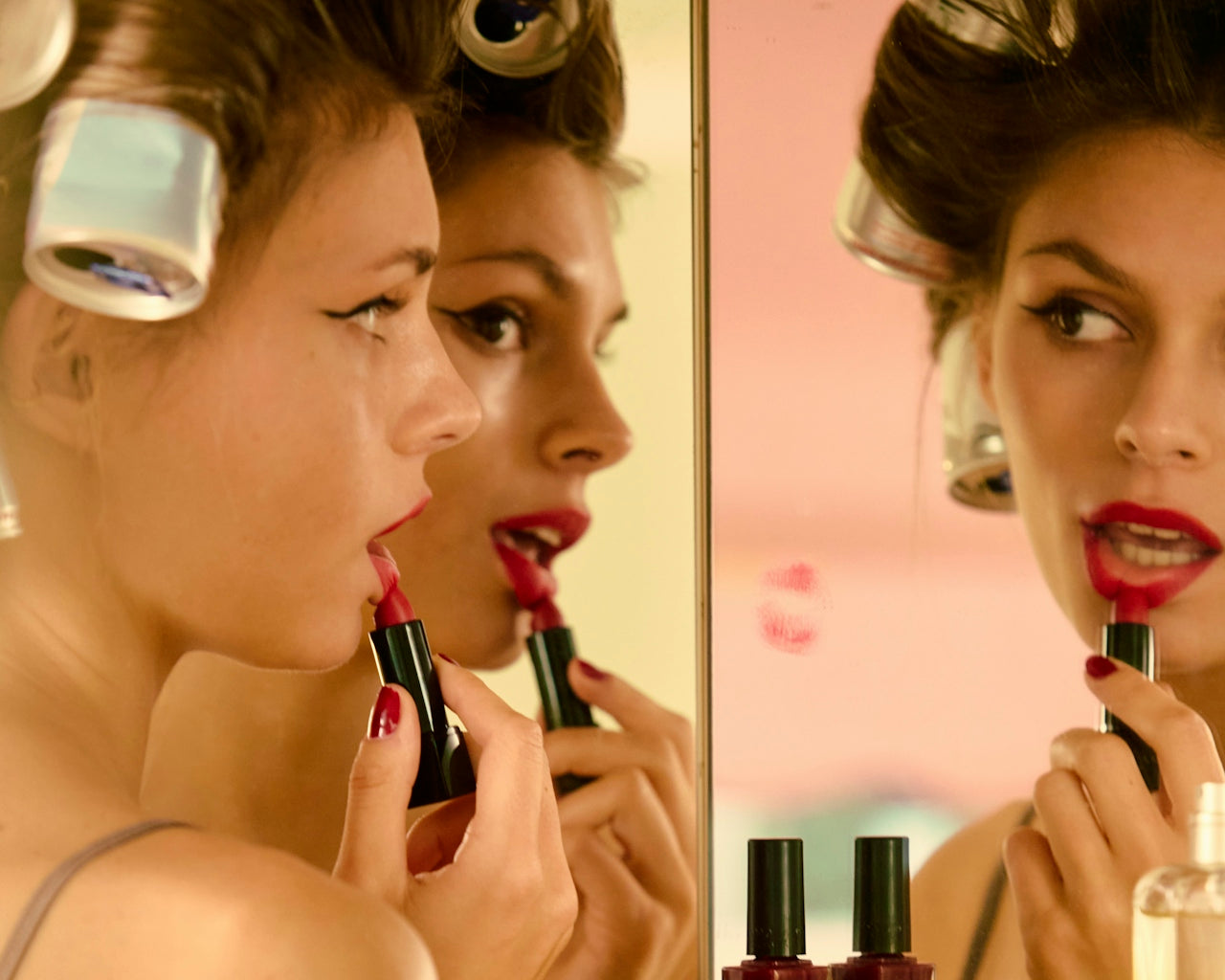
The Solo Pleasure Revolution: Why knowing yourself is your Superpower
Often, society has sold us the idea that sex is a team sport. And while sharing is wonderful, the reality is that the longest, most stable, and most fundamental erotic relationship you will ever have is with yourself. At Shop Tangere, we don’t see masturbation as a "Plan B" for when a partner isn't around; we see it as high-fidelity training for your overall well-being. Self-knowledge as your compass Imagine going to a restaurant and the server asks what you’d like to eat, but you have no idea what you like. Chances are, you’ll end up accepting whatever they suggest, even if it doesn't thrill you. The bedroom is no different. You are both the map and the treasure. If you don’t know what kind of pressure your clitoris responds to, which rhythm makes your pulse race, or which angles are your personal favorites, it’s difficult to give a "co-pilot" precise instructions. Knowing yourself gives you an assertive voice: you stop waiting for someone to guess and start guiding with confidence. Beyond the orgasm: The chemical payoff It’s not just about reaching the finish line; it’s about what happens to your body along the way. A solo moment is a cocktail of wellness: Goodbye cortisol: The accumulated stress from work or daily routine dissolves in the face of endorphin release. Better sleep: Oxytocin and dopamine act as the world’s most potent natural relaxants. Radical self-esteem: There is something deeply empowering about knowing that you hold the keys to your own pleasure. That translates into a more confident stance in every area of your life. Elevating the experience... Don't treat it like a chore. Turn that moment into a luxury date with yourself. Turn off your phone, put on that playlist that makes you feel sexy, and use a high-quality oil or lubricant to awaken your senses. Remember: A great toy isn’t there to replace sensations, but to amplify them, allowing you to explore intensities that hands sometimes can’t reach due to fatigue or technique.

Intimacy With Yourself: A Practice of Self-Knowledge
Intimacy is often framed as something we share with others.But some of the most meaningful intimacy exists in the relationship you build with yourself. Self-intimacy is not about performance or expectation.It is about listening, curiosity, and honesty about allowing yourself to be fully present with your own sensations and emotions. At Tangere, we see intimacy with oneself as a lifelong practice of self-knowledge. What self-intimacy really means Self-intimacy is the ability to be with yourself without distraction or judgment.It is noticing what feels good, what feels uncomfortable, and what feels neutral without trying to change it. This kind of intimacy: Builds emotional awareness Encourages self-trust Deepens your connection to your body It is not about achieving anything.It is about understanding yourself more deeply. Listening without expectation Many of us approach our bodies with goals: to improve, to fix, to control.Self-intimacy asks for something different presence without agenda. When you remove expectation, you allow space for genuine sensation to emerge.You begin to recognize patterns, preferences, and boundaries that are uniquely yours. Listening without expectation is an act of respect. Curiosity as a form of care Curiosity invites softness.Instead of judgment, it asks questions. What feels grounding today?What does my body need right now?What brings me calm, warmth, or ease? Approaching intimacy with curiosity transforms it into a caring dialogue between you and your body. Intimacy as a mirror Self-intimacy often reveals more than physical sensation.It reflects emotional states, energy levels, and inner rhythms. In moments of stillness, you may notice: Where you hold tension How your breath responds to touch What sensations feel nourishing or overwhelming These insights extend beyond intimacy and into daily life, shaping how you relate to yourself and others. Creating safety within yourself True intimacy requires safety.When practiced alone, it becomes an opportunity to create a space where you can fully relax. A sense of safety allows the nervous system to soften, making it easier to feel pleasure, comfort, and presence. Self-intimacy becomes a quiet reminder:you are allowed to take up space within yourself. Objects as companions in exploration When chosen with intention, objects can support the process of self-discovery.Not by leading, but by accompanying. At Tangere, our pieces are designed to: Feel intuitive and non-intrusive Encourage awareness rather than distraction Support exploration at your own pace They exist to support your relationship with yourself, not define it. Intimacy evolves with you Your relationship with yourself is not static.What feels supportive today may shift tomorrow. Self-intimacy honors change.It adapts to your emotional state, your energy, and your needs. There is no fixed destination only an ongoing conversation. Choosing connection in 2026 This year, we invite you to deepen the relationship that shapes all others: the one you have with yourself. Self-intimacy is not indulgence.It is awareness.It is care.It is self-knowledge. Explore intimacy at your own pace. Explore Tangere.

Rituals of Pleasure: Creating Intimate Moments in Your Daily Life
Pleasure becomes more meaningful when it is intentional.Not rushed.Not accidental.But consciously chosen. Rituals of pleasure are not about adding more to your day.They are about slowing down, creating space, and allowing yourself to fully arrive in your body. At Tangere, we see rituals as a way to transform everyday moments into experiences of presence and connection. What makes something a ritual? A ritual is not defined by how long it lasts or how elaborate it is.It is defined by attention. A ritual has: A beginning and an end Intention behind it Presence within it Unlike habits, rituals invite feeling rather than performance.They are not about efficiency they are about experience. Creating space for intimacy Intimacy begins with space.Space from noise, from notifications, from expectations. Creating a ritual of pleasure starts with choosing a moment that belongs only to you.Even a few uninterrupted minutes can become deeply grounding when treated with care. Consider: Dimming the lights Soft textures against the skin A quiet environment that allows you to breathe more deeply The environment does not need to be perfect it only needs to feel safe and intentional. The importance of slowing down Pleasure is rarely found in rush.The body opens when it feels unhurried. Slowing down allows you to: Notice subtle sensations Tune into your breath Move at a pace that feels natural Rituals invite you to release urgency and replace it with curiosity. There is no destination only the experience itself. Rituals as a form of grounding In a fast-moving world, rituals offer stability.They signal to the body that it is safe to relax. A consistent ritual of pleasure can: Reduce stress Improve emotional regulation Strengthen the connection between mind and body These moments become anchors gentle pauses that support your overall well-being. Objects that support ritual, not distraction The objects you bring into your rituals matter.Not because you need more things, but because quality and intention shape experience. At Tangere, we design objects to: Feel natural in your hands Blend into your space with elegance Support presence rather than distraction A well-designed object does not demand attention.It quietly enhances the moment. Making pleasure part of your routine Rituals do not need to be reserved for special occasions.When practiced regularly, they become part of how you care for yourself. A daily or weekly ritual of pleasure can: Reconnect you with your body Reinforce self-trust Create moments of calm in your routine Consistency builds familiarity, and familiarity deepens connection. Your ritual, your rhythm There is no universal way to experience pleasure.Your ritual should reflect your needs, your pace, and your curiosity. Some days may call for stillness.Others for movement, warmth, or exploration. Rituals are not fixed they evolve with you. Choosing intention in 2026 This year, we invite you to choose intention over urgency.To create moments that feel nourishing rather than performative. Rituals of pleasure are a reminder that you deserve time, attention, and care without justification. Create rituals that honor your body. Explore Tangere.

The Art of Seduction – Iconic Movie Inspiration
Seduction in cinema has never been innocent. It is stressful. Power. Control. It lives in what is delayed, in what is suggested, in what is desired without being explained. Iconic films have taught us that seduction is not about being liked, it is about commanding space, rhythm, and attention. This piece explores the art of seduction through a more provocative lens, inspired by films that transformed desire into narrative, aesthetic, and attitude and how those codes remain alive today, quietly refined, intentional and elegant. Seduction does not ask for permission Truly seductive characters do not seek approval. They impose presence. In Basic Instinct, Catherine Tramell never explains herself or apologizes. Her power lies in the discomfort she creates. She holds eye contact, speaks only when necessary, and controls every gesture. She seduces because she doesn’t need to. In Fifty Shades of Grey, seduction is built through ritual, luxury, and anticipation. Christian Grey represents modern desire: polished, dominant, restrained. He doesn’t promise love, he promises experience. And that is infinitely more dangerous. Real seduction is not romantic. It is strategic. Desire, control, and the forbidden Cinema understands that desire intensifies when boundaries exist when something is not fully accessible. Eyes Wide Shut turns seduction into a psychological ceremony: masks, secrets, enclosed spaces. Everything is slow, unsettling, and deliberate. Eroticism doesn’t live in the body, but in the tension. The Dreamers explores a more raw and artistic form of seduction: young bodies, ruleless intimacy, desire as rebellion. Here, there is no restraint, only emotional excess. And In the Mood for Love proves that not touching can be the most seductive act of all. Repression, when elegant, becomes unbearable. Across all these stories, the message is clear: desire does not shout it is constructed. Seductive aesthetics: when luxury becomes a weapon Cinematic seduction has always been deeply tied to image. This is no coincidence. Fifty Shades of Grey: dark minimalism, cold interiors, impeccable tailoring, luxury as a language of power Basic Instinct: absolute white, clean lines, intellectual sexuality Eyes Wide Shut: velvet textures, shadows, masks, concealed eroticism In the Mood for Love: body-hugging dresses, rich colors, slow movement Seductive style is never loud. It is precise. Every element exists for a reason. Icons who redefined seduction Cinema does not create trends it creates archetypes. Sharon Stone: unapologetic feminine power Marlene Dietrich: ambiguity, androgyny, defiance Alain Delon: cold beauty, emotional distance They all share one thing: they never fully give themselves away. That is where their magnetism lives. Contemporary seduction: less skin, more intention Today, seduction has evolved. It is no longer about showing everything, but about choosing what to reveal. Fashion, cinema, and design now converge around the same idea: desire as a curated experience. Lingerie is no longer decorative, it becomes architecture for the body. Pieces designed not for external validation, but for an internal sense of control, comfort, and quiet confidence. Intimate objects follow the same philosophy: clean lines, soft materials, technology that remains almost imperceptible. True seduction lies in their presence not in interruption, not in announcement, not in noise. Just like cinema, what matters most is what is implied, not what is displayed. This approach, intimate, discreet, intentional redefines pleasure as something personal, elegant, and deeply modern. The luxury of silence If cinema has taught us anything, it is that real luxury is not excess, it is intention. Ordered spaces, controlled gestures, experiences designed to be enjoyed without witnesses. Within that silence lives a new form of seduction: pieces and objects that integrate seamlessly into everyday life without disrupting aesthetics, without demanding attention, without explanation. Because sophistication is also found in what no one else sees. Cinema has shown us that seduction is neither a technique nor a learned gesture. It is an attitude. A way of moving through the world. To seduce is to know when to approach and, more importantly, when to withdraw. Today, that philosophy translates into conscious choices: how you dress, what you choose for your intimacy, how you design your own desire. Because what is truly irresistible never begs for attention. It commands it quietly.