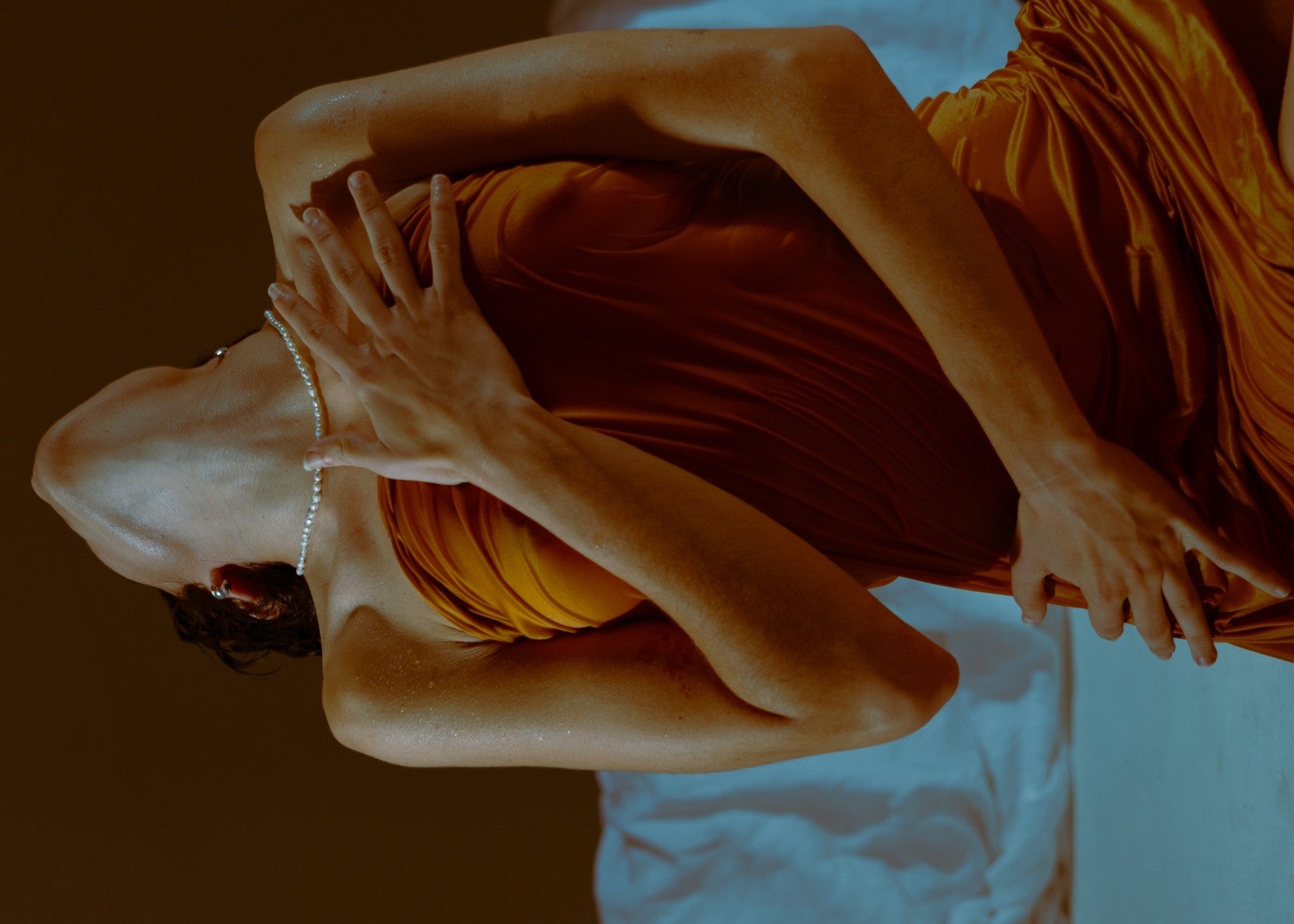
How watching yourself interferes with feeling anything
There is a specific and common experience that interferes with pleasure more reliably than almost any physical factor, and it has nothing to do with the body's actual capabilities. It is the experience of monitoring oneself from the outside during intimacy, of being half-present in the moment and half-occupied with how one looks while in it. The research term for it is self-objectification, and its effect on sexual response is direct, measurable, and largely invisible to the person experiencing it.
The mechanism is a matter of where attention goes. Pleasure requires attention to be inside the body, registering sensation as it happens. Self-monitoring pulls attention out of the body and into an imagined external viewpoint, where it is busy evaluating the appearance of a stomach, an angle, a movement, a comparison to some remembered or imagined standard. Attention is finite. It cannot be fully inside the experience and fully observing the experience from the outside at the same time. The observation wins by default, because anxiety is loud, and what is lost is the sensation itself.
Studies in this area consistently find that the habit of viewing one's own body as something to be evaluated is associated with reduced arousal, more difficulty reaching climax, and lower sexual satisfaction overall. The crucial finding underneath this is that the effect tracks with the self-monitoring, not with any objective feature of the body. Two people with bodies a neutral observer would rate identically can have entirely different experiences, determined not by how they look but by how much attention they spend watching themselves look. The body was never the variable. The watching was.
This reframe matters because the usual proposed solution, changing the body itself, addresses the wrong thing. A changed body monitored just as intently produces the same interference. The problem is not the object being observed. It is the act of observing, the redirection of attention away from feeling and toward appearance. Solving it requires not a different body but a different allocation of attention.
The skill being described is, in essence, the same one that appears throughout the study of pleasure, which is presence. The ability to keep attention inside the body, registering what is actually happening, rather than floating outside it to evaluate the scene. It is trainable, like any direction of attention, and it begins with noticing the moment the mind leaves the body to go watch from across the room, and gently declining the invitation.
The most reliable barrier to pleasure, for an enormous number of people, is not located in the body at all. It is located in the habit of watching the body instead of inhabiting it.