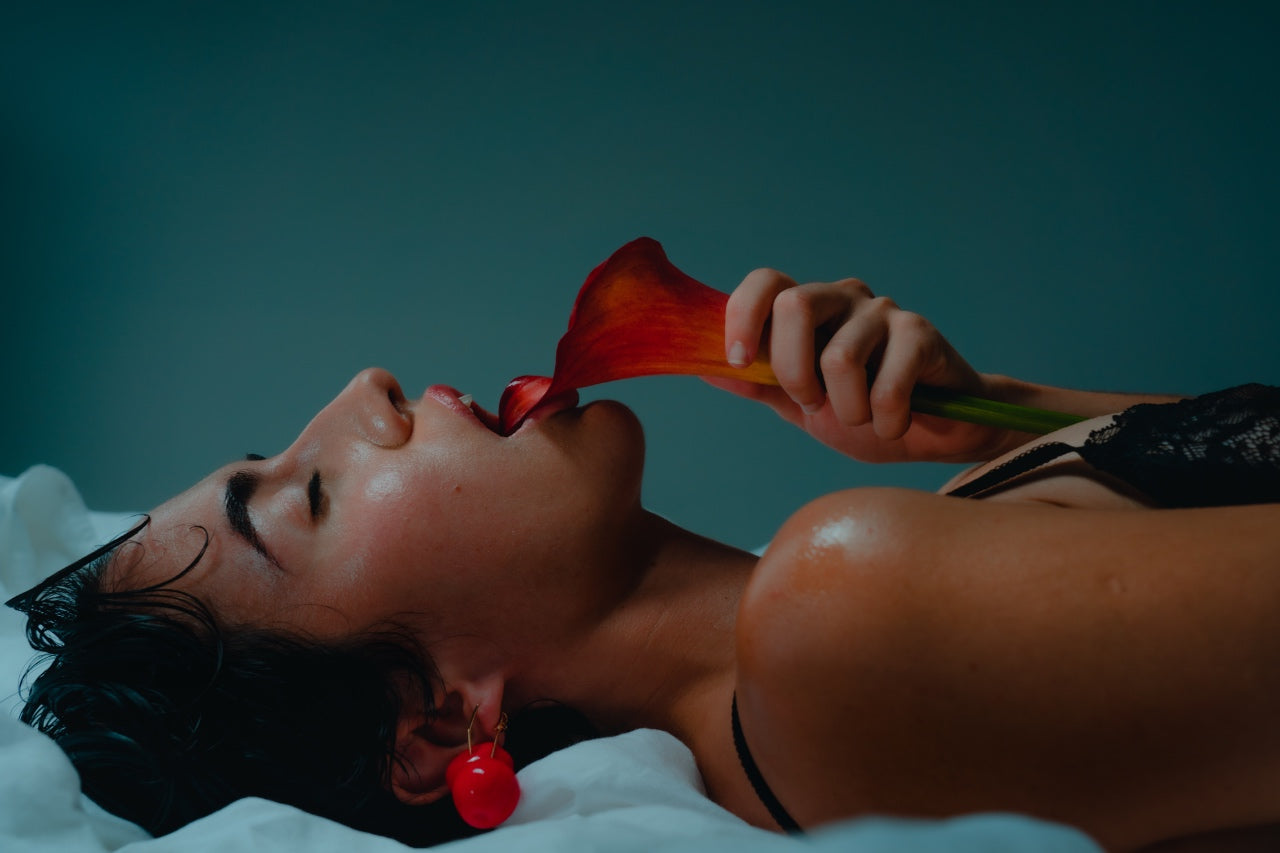
Walk into any lingerie section, scroll through any intimate apparel collection, and red is always there. Not as a trend that comes and goes. As a constant. A given. A color so embedded in the language of desire that its presence barely registers as a choice anymore.
But it is a choice. And the psychology behind it is more layered than most people realize.
Red is the most emotionally activating color in the visible spectrum. This is not a cultural construct, or at least not entirely. Research in color psychology and evolutionary biology suggests that the human response to red runs deeper than aesthetics, deeper than fashion, deeper than what any particular culture has decided to associate with romance or danger or passion. It is, in significant part, a biological response.
Start with the evolutionary context. In many primate species, reddening of the skin signals fertility, health, and sexual readiness. Humans are not immune to this signal. Studies conducted across multiple cultures have found that men rate women as more attractive and more sexually appealing when they are associated with the color red, even when all other variables are held constant. The effect occurs whether the red appears in clothing, in background color, or in framing. It appears to operate below the level of conscious processing.
But the psychology of red is not only about attraction from the outside. It also operates internally, on the person wearing it.
Research on color and self-perception shows that wearing red increases self-reported feelings of confidence, dominance, and assertiveness. In competitive contexts, people wearing red perform better and are perceived as more formidable by opponents. In social contexts, they are rated as more charismatic and more memorable. The color does not just signal power to others. It activates a sense of power in the wearer.
This is partly physiological. Red has been shown to increase heart rate and elevate arousal levels in ways that are measurable in the body. It stimulates the sympathetic nervous system, the same system activated by excitement, by anticipation, by the early stages of desire. Wearing red does not just look like energy. It generates it.
There is also the cultural layer, which has accumulated over millennia and cannot be separated from the biological one. Red has been associated with love, with passion, with danger, with celebration, with the sacred across virtually every human culture that has left a record. That accumulated meaning does not disappear when you put on a red lace set. It travels with the color. Your nervous system has absorbed it, even if you have never consciously thought about it.
The combination of these layers, biological signal, physiological activation, and cultural resonance, is what makes red uniquely powerful in intimate contexts. It is not simply that red looks good. It is that red does something. To the person looking. And to the person wearing.
At Tangere, red is not just a color option in our collection. It is a statement. One that has been understood, across cultures and centuries, to mean something specific. You already know what it means. Your body knew before you did.